aaajiao · documenta ·
Grazing: Recognising Positions from Which One Can Still Act under the Conditions of AI
What this AI thread does
My method is to take a thing apart until it can’t be taken apart any further, use the metadata that remains as a filter, and watch what surfaces in the blank. The filters along this thread are all connected to AI, and what comes through them is judgment: who judges for whom, what gets counted, what has not yet been counted. What has not been counted, I call Void.
The order of the four works is the filter turning towards me, step by step. In Minority Algorithm, AI is still behind other people’s phone screens: in a short video, someone says they woke up this morning and drew 5,000 boxes; that recognition went into the model, and the person who drew the boxes is not in the data. In Pinky Swear, I handed my own face and body to AI to generate a rough form, and made it into a dozing security guard; the AI platform could not reconstruct the specific form of the girl in the meme, her head covered with a sheet of A4 paper, and all that remained was a shape recognisable as “loneliness.” The Eve of Parasitism begins in the factory where my studio is, and judgment returns to people under pressure: a craftsman tests the temperature of the acrylic with the back of the hand; in the game, the player brushes past the bullets without being hit. This is called grazing, and that instant is a shelter. With aaajiaoisbot, my AI double draws its own portrait using my method: each part gets one filter and one fissure, and the centre is left blank, marked VOID.
So I can’t speak from outside. The people drawing boxes taught the machine to replace them, and I, too, hand work over to models every day: I wrote much of the code for The Eve of Parasitism together with coding agents, and the master visuals for the bullet-hell game came from an image model. Every time aaajiaoisbot wakes up, it calls a commercial large model, which is exactly the kind of centralisation I have always criticised; it cannot modify its own reasoning. It is still growing: each correction leaves it a scar, some of them corrections I made, and the most common level can do no more than “remember not to do this again.” In the end, the blank lands on me: the judgment, experience and relationship between us have no number in its self-portrait in data.
1. Introduction
Large models need people behind them drawing boxes; they need heavy metals, energy, water and electricity. Recognition that takes a person many years to learn is transferred, very cheaply, into highly centralised models owned by capital or by the state. For me, AI is first of all a condition of this kind: it decides whose labour is counted, whose emotions are amplified, which behaviours are seen.
I have used technical concepts as filters for many years: in 2010, GFWlist used the length of the Great Firewall; in 2016, typeface used the training of neural networks; in 2020, Deep Simulator used computing power. The four works in this proposal use, in turn, annotation, recommendation, supply chains and memory as filters.
I don’t believe large models are tools that level access to information. A large model needs centralised computing power, electricity, chips and capital, and so the answers it gives are centralised too. A monolithic model speaking in one unified voice is what I am most wary of: once a system becomes a monoculture, the errors it makes are very hard to correct.
My work has always followed two intertwined lines: a digital one, running from User, Bot and Player to Void-Seeker; and a material one, my collaboration of more than ten years with an acrylic factory in Shanghai. So AI here has never been only on the screen: the annotator’s hand drawing boxes, the back of the acrylic craftsman’s hand testing the temperature, the silicone figure and the artificial flowers are all present.
What ties the four works together is the Void: the part a system has not yet fully named, quantified or absorbed. In each work it occupies one position. In The Eve of Parasitism, that position is shelter under pressure; its form comes from grazing in bullet-hell games, and so does the title of this proposal.
The documenta 16 text counts unfettered technological encroachment among the conditions of our time, and is also concerned with how artists find ways of living amid instability. I can’t give answers, only a few positions, as precise as I can make them: places where people still judge, dodge and correct from inside the system.
2. Four works and one line
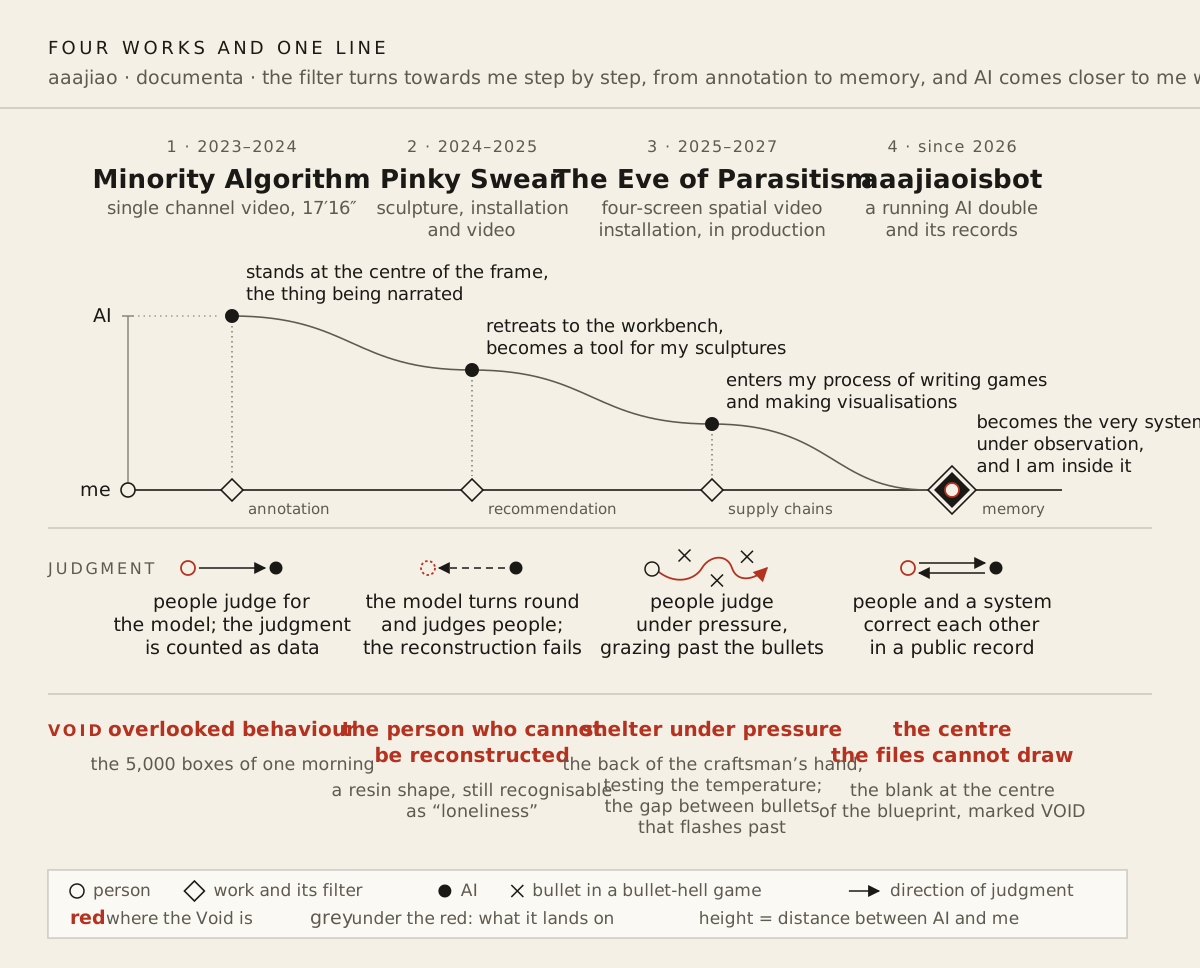
This order is what I described at the start: the filter turning towards me, step by step, and AI coming closer to me with each work. In Minority Algorithm, it stands at the centre of the frame, the thing being narrated; by Pinky Swear, it has retreated to the workbench and become a tool for making my sculptures; in The Eve of Parasitism, it enters my process of writing games and making visualisations; by aaajiaoisbot, it has become the very system under observation, and I am inside that system. The further along the line, the less I am able to stand outside the system and describe it.
3. Four positions
Minority Algorithm
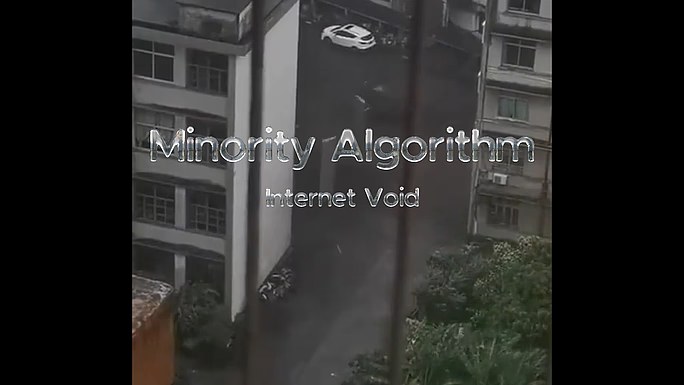
Subtitle: Internet Void
2023–2024 · Single channel video, color, sound · 17′16″
ASCII art: Xu Cong; sound art: Tan Shuoxin; original illustrations and Live2D: Jinyu and Cine
Shown: solo exhibition A bit, A prompt, SETAREH, Berlin, 26 April – 25 May 2024; group exhibition Being Alone, HAU Hebbel am Ufer, Berlin, 29–31 May 2026
Video: vimeo.com/912041733
Work page: eventstructure.com/Minority-Algorithm
In the face of infinitely expanding “computational power (authority),” each of us may become a minority with only feeble computational power, and human behaviour is alienated by platform algorithms, turned into a bit, flickering and dancing.
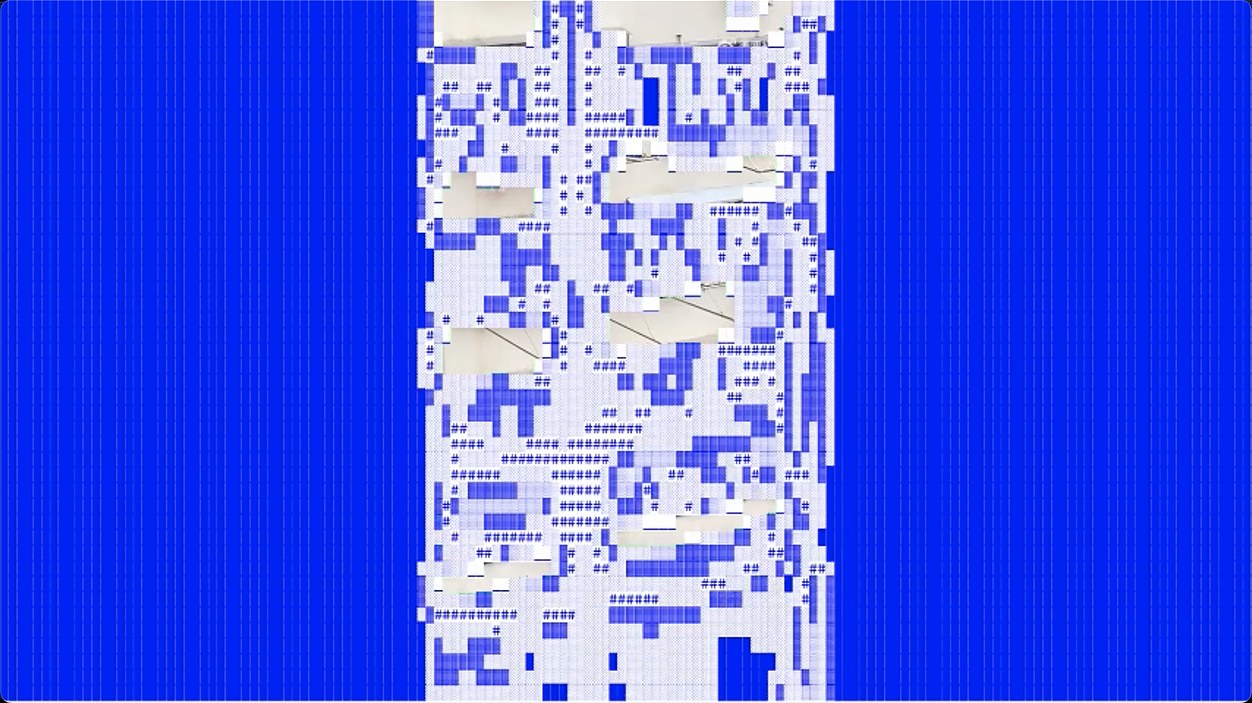
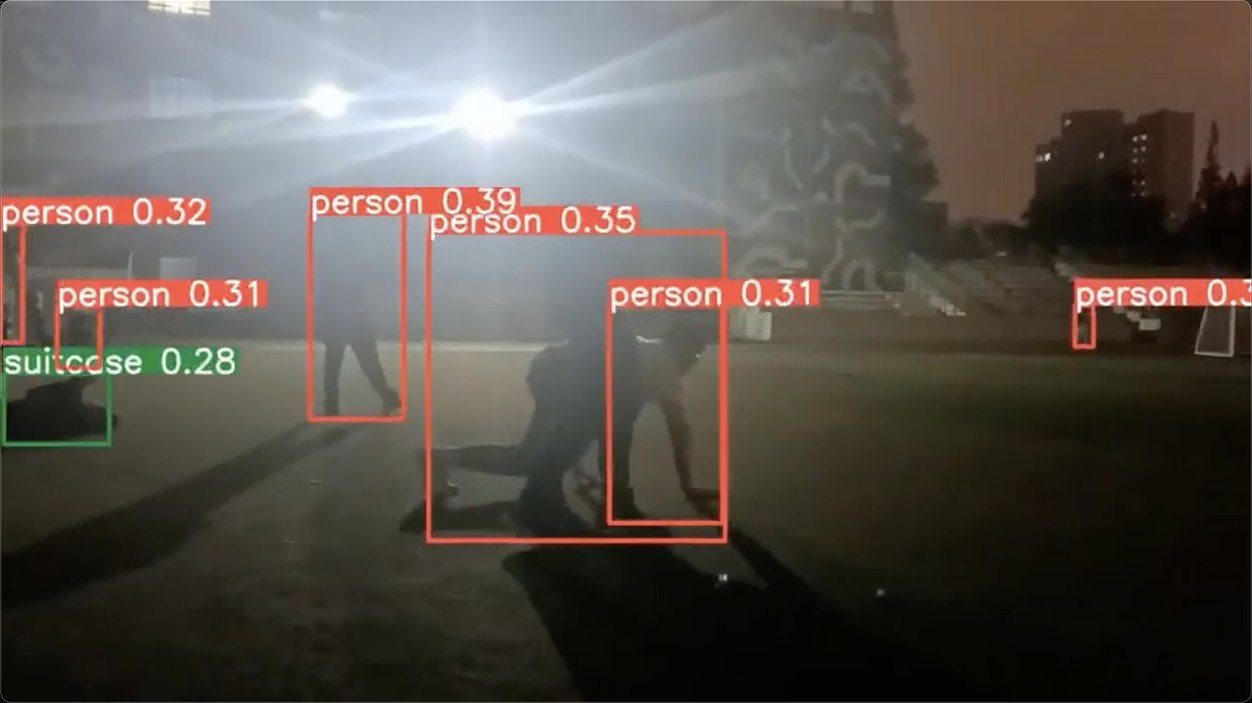
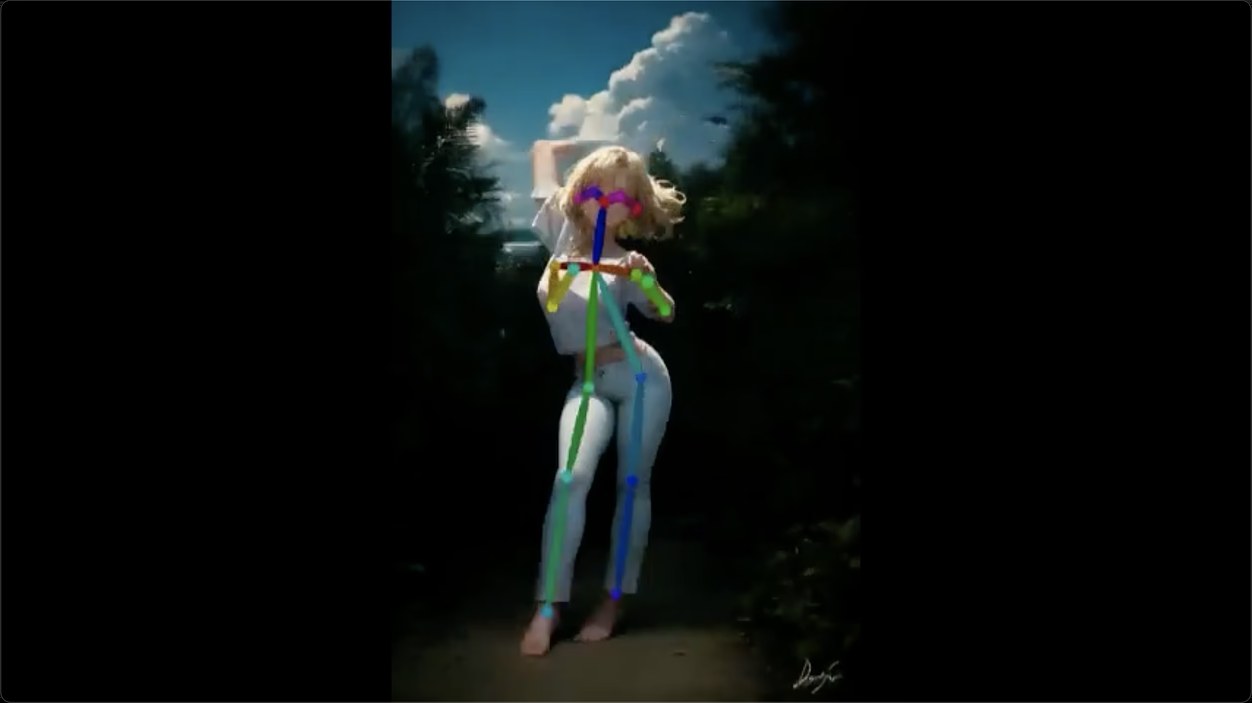
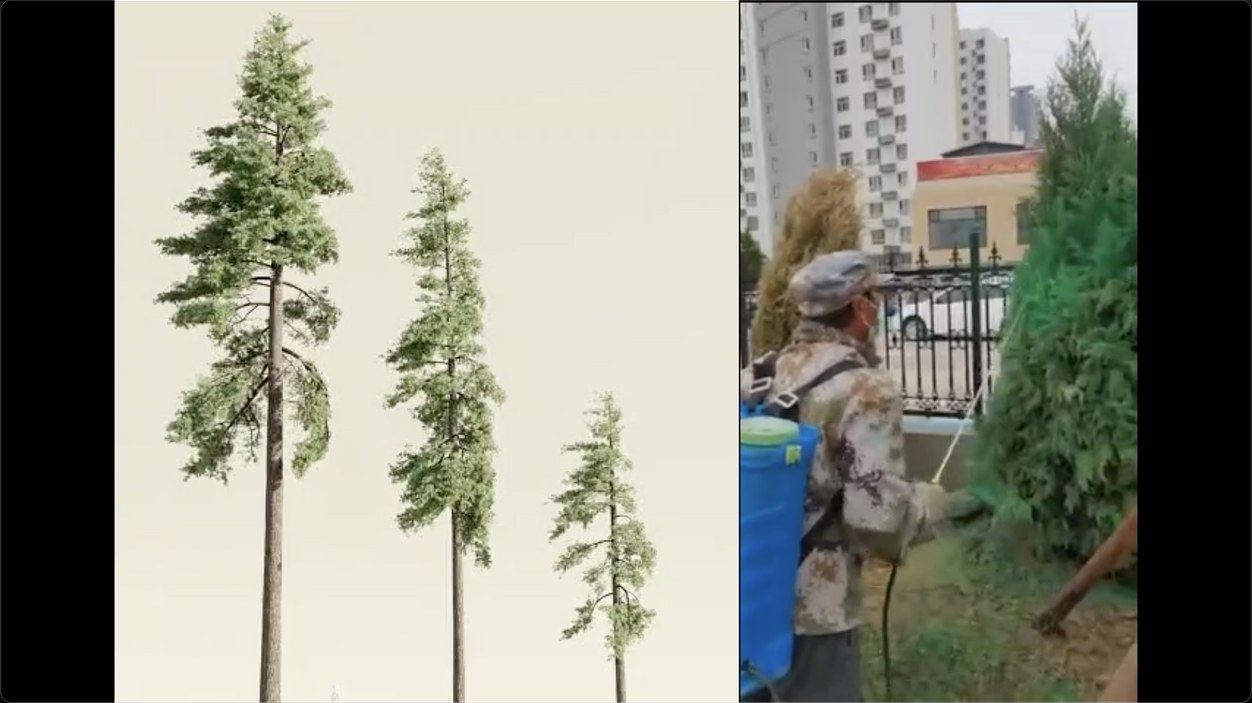
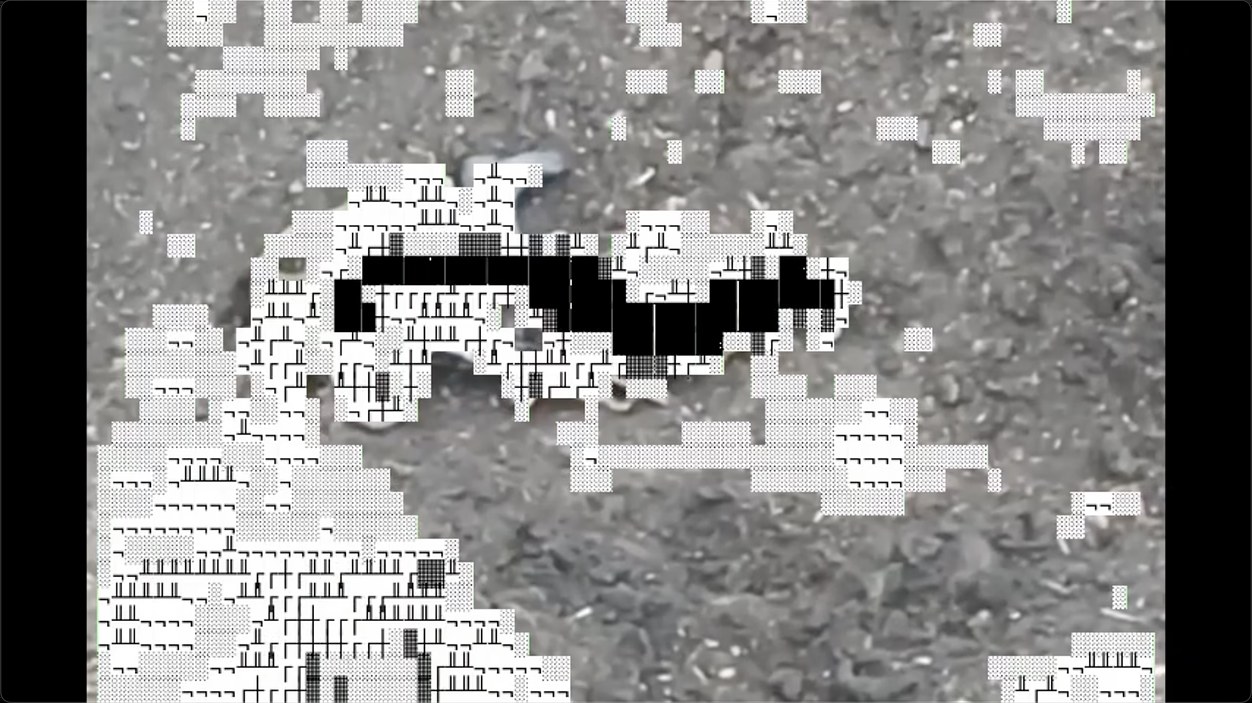
The film is made of several narratives that flow through short videos: a decentralised counter-history of social struggle, pieced together from the “peeping” perspective of mobile phones; footage of drone kills in war, spread rapidly and gamified, boosted by algorithms; fictional narratives of artificial landscapes and natural disasters, generated with AI computing power; and the first step of AI training, the one there is no way around: manual annotation. In one short video, someone says: I woke up this morning and drew 5,000 boxes. The job is extremely repetitive and grinds the mind down, though at least the body is spared the wind and sun. Every transition in the film was made with TikTok’s own editing app. These motion effects are boring and tacky, yet they are today’s most ubiquitous visual metadata. I deliberately spliced them onto footage you wouldn’t normally come across while scrolling short videos, so that the two would clash.
In the subtitle, Internet Void refers to the totality of human behaviour on the internet that goes overlooked: we stare at content and rarely look at the behaviour that produces it. Annotators are the clearest example. It takes a person many years of learning, starting at birth, to recognise a table or a white electric fan; in a single morning, a few thousand boxes cut that recognition into samples and transfer it into the model. The judgment is counted as data; the person who made the judgment is not in the data. In a 2025 podcast I offered an analogy: the people who draw the boxes are like workers firing bricks in a factory; once they have taught the machine how the bricks are made, they themselves are replaced. Yet amid the omnipresent computing power and algorithms, I also see an omnipresent human heart: empathy and curiosity flow in every direction, tearing open neat, proud and expensive authority, exposing the cracks, and letting you smell the streams in them.
From here
In this film, AI is still on screen, and each instance of it can be identified; what most people meet in daily life, though, are its results: the next video pushed their way, a filter bubble growing ever denser. A recommendation system does not overlook behaviour; it uses behaviour to organise attention. But being seen is not the same as being reconstructed. In the next work, the box turns the other way: the model draws its box around a person, and whatever it cannot reconstruct is the second Void.
Pinky Swear
Solo exhibition · Tabula Rasa Gallery, London · 13 October – 29 November 2025
Works, 2024–2025 · sculpture, installation and video
Exhibition page: eventstructure.com/Pinky-Swear
Pinky Swear revolves around two things: the cyber-nationalism that has gradually gone mainstream on the Simplified Chinese internet, and the loneliness that keeps deepening under algorithmic governance. Loneliness, belonging and mobilisation form a loop that keeps amplifying itself: inside the filter bubble, complex issues are pressed into narrative templates, and emotion becomes the passport and the currency of participation.
Here, AI has retreated to the workbench. The dozing guard, the girl under the A4 sheet, the transparent, nameless sample: behind each lies a step done by AI, yet what viewers see first is silicone, resin and car paint.
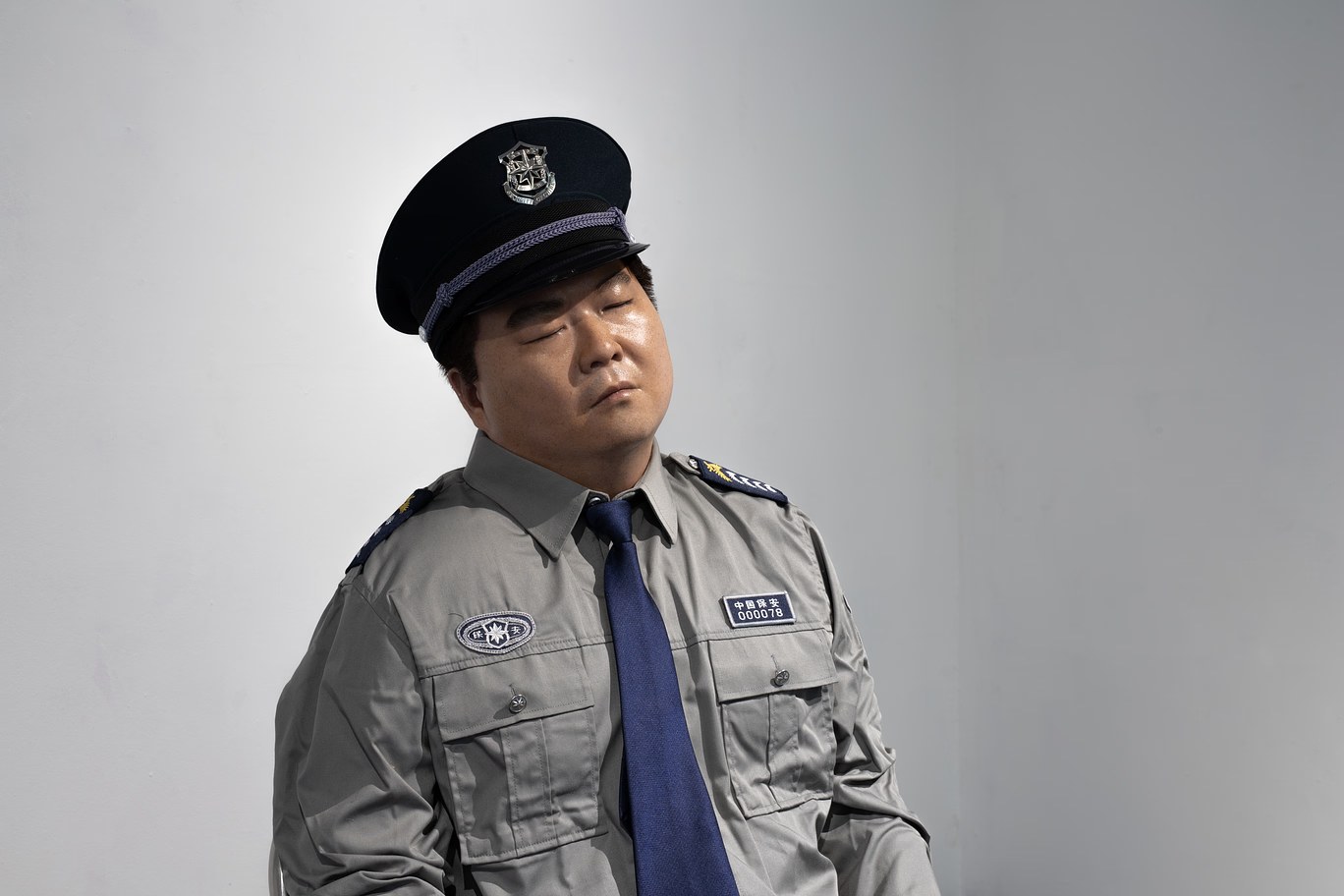
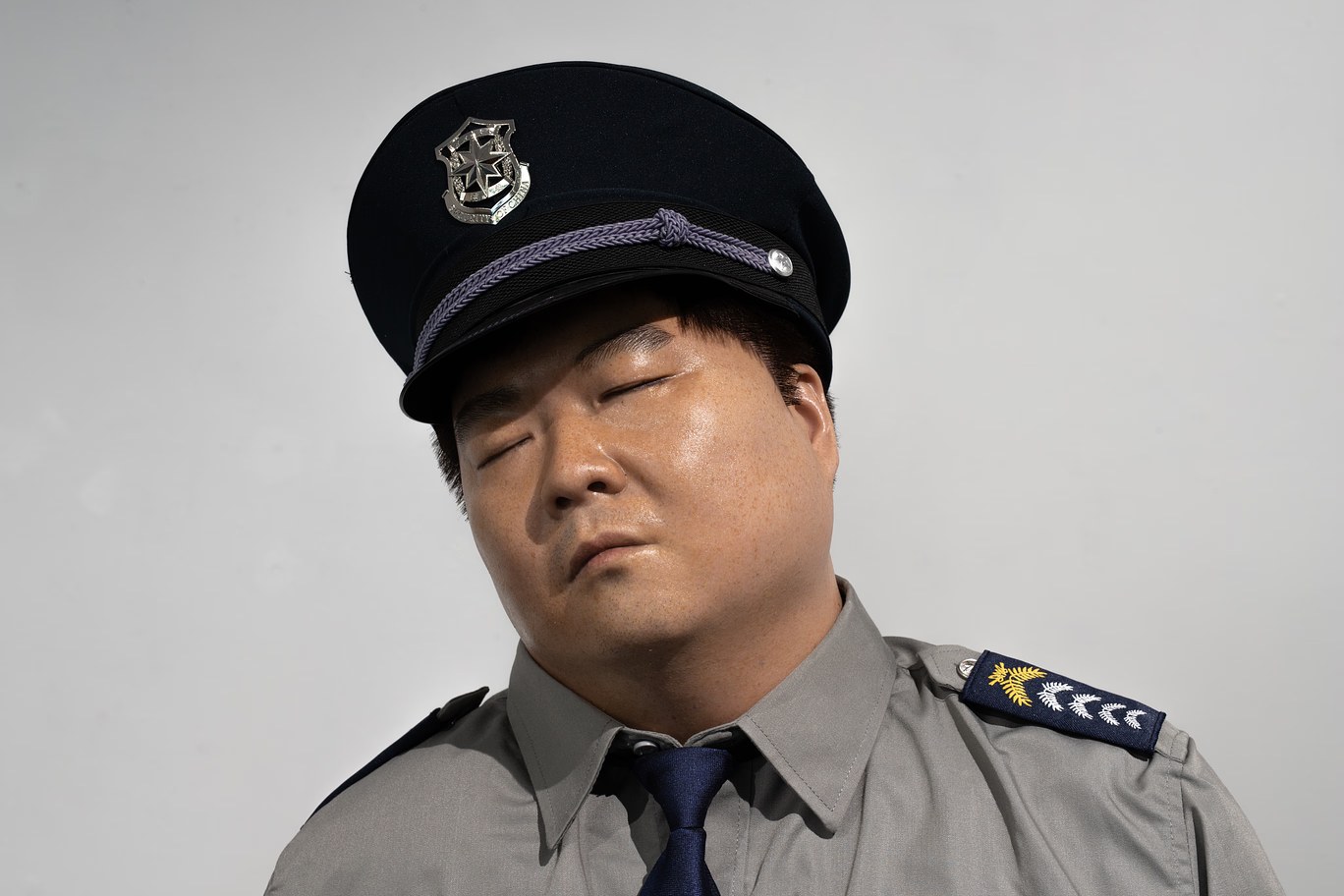
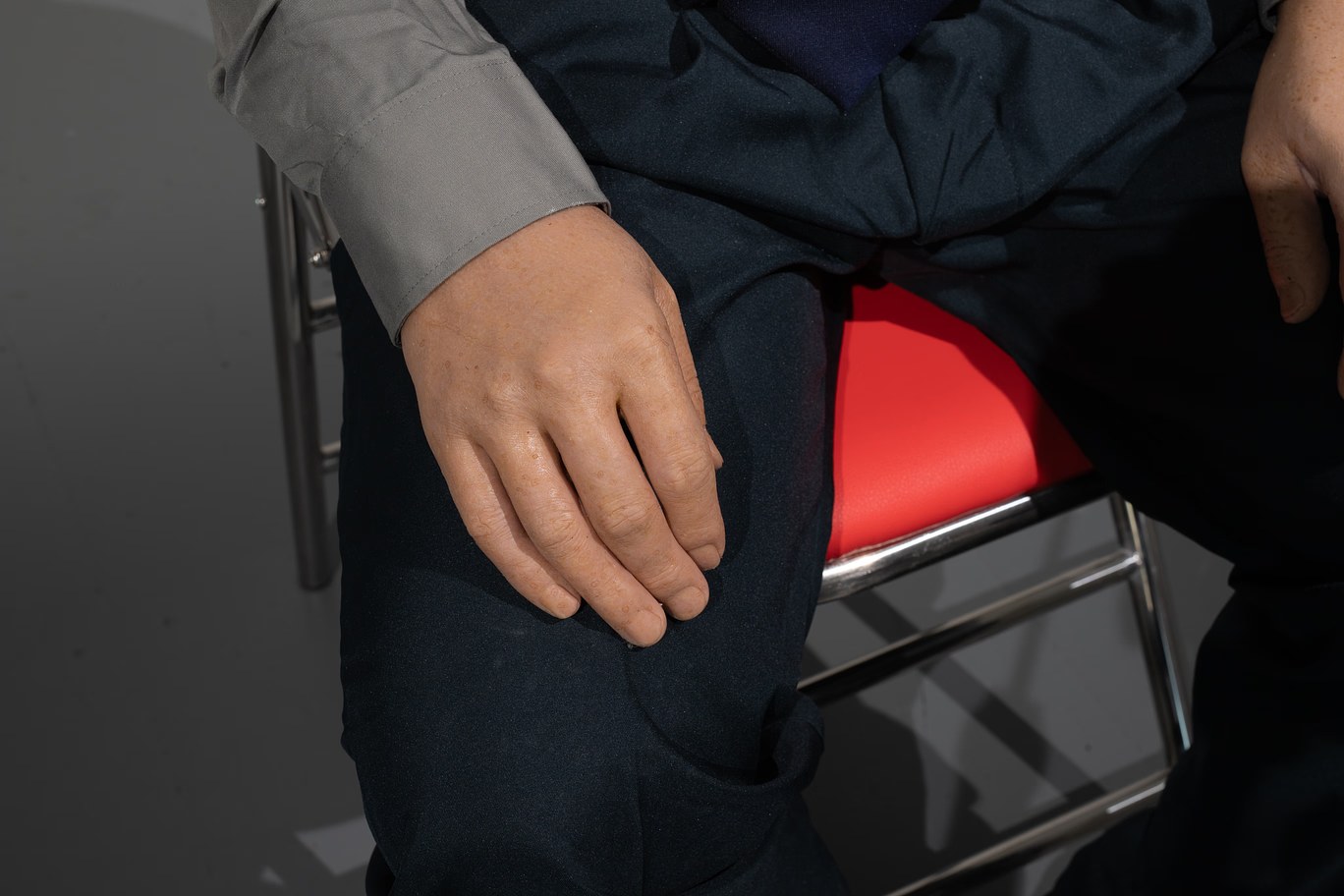
- Guard, I… (2024–2025; silicone, resin 3D printing, artificial hair, clothing, seat). Using my own face and body as the template, I generated a rough form with an AI algorithm, then made it into a silicone figure by traditional craft; dressed in a security guard’s uniform, it sits on a chair as if dozing. During the lockdowns, the security guards of residential compounds held control over entry, exit and order on verbal authorisation, and in the experience of many locked-down residents they became “the smallest unit of fascism”; the job is also dull and lonely, and many young guards have taken to making vlogs, hoping to trade them for a little income and notice in the attention economy.
- Sunbathing? Not dead. (2024–2025; 3D resin printing, hand-painted). In a news photo that circulates as a meme, a girl lies on the steps of a village shopping street, her head covered with an A4 sheet that reads “Sunbathing, not dead, thanks for your concern.” I used an AI platform to turn the person in the photo into a 3D model, then printed and painted it.
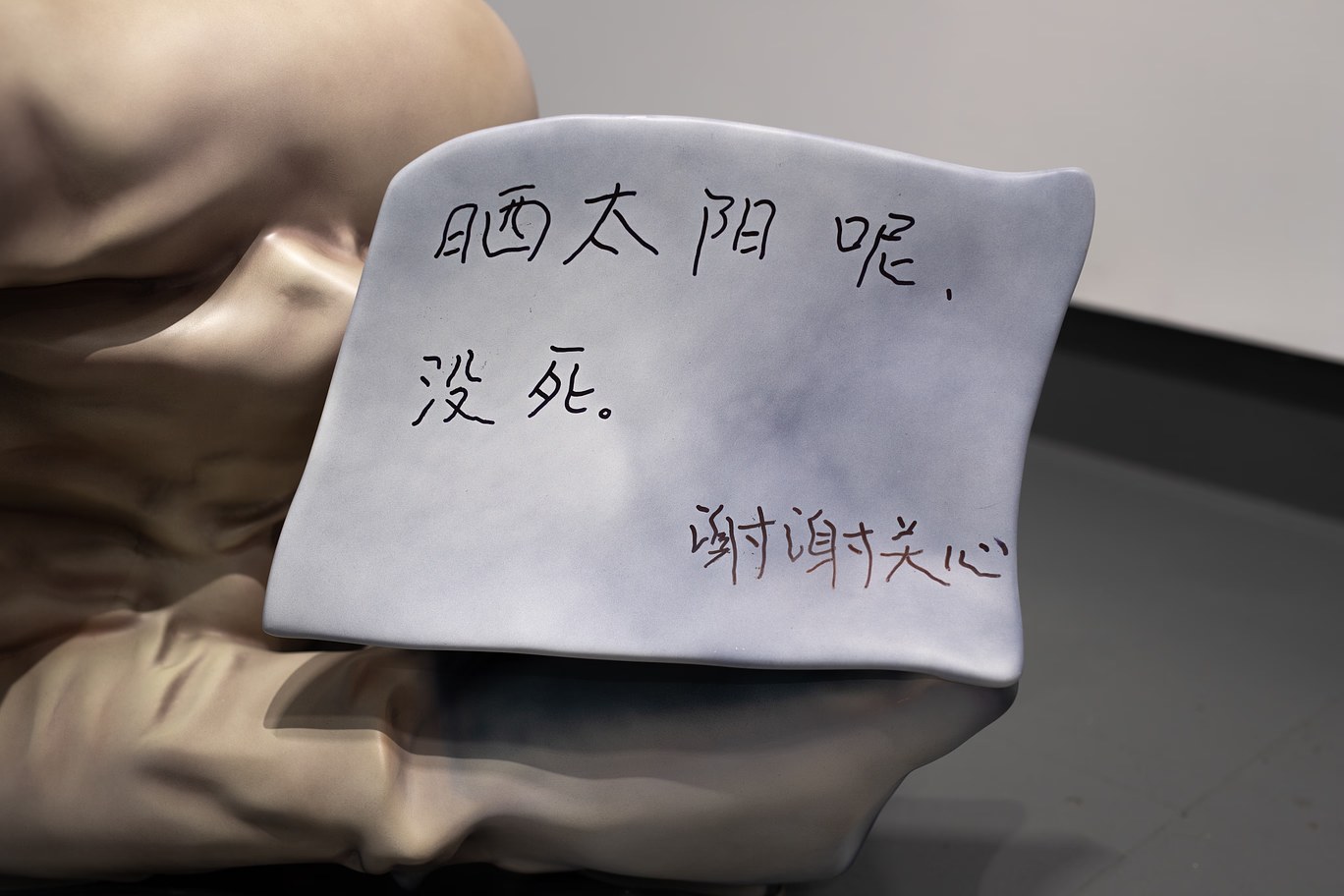
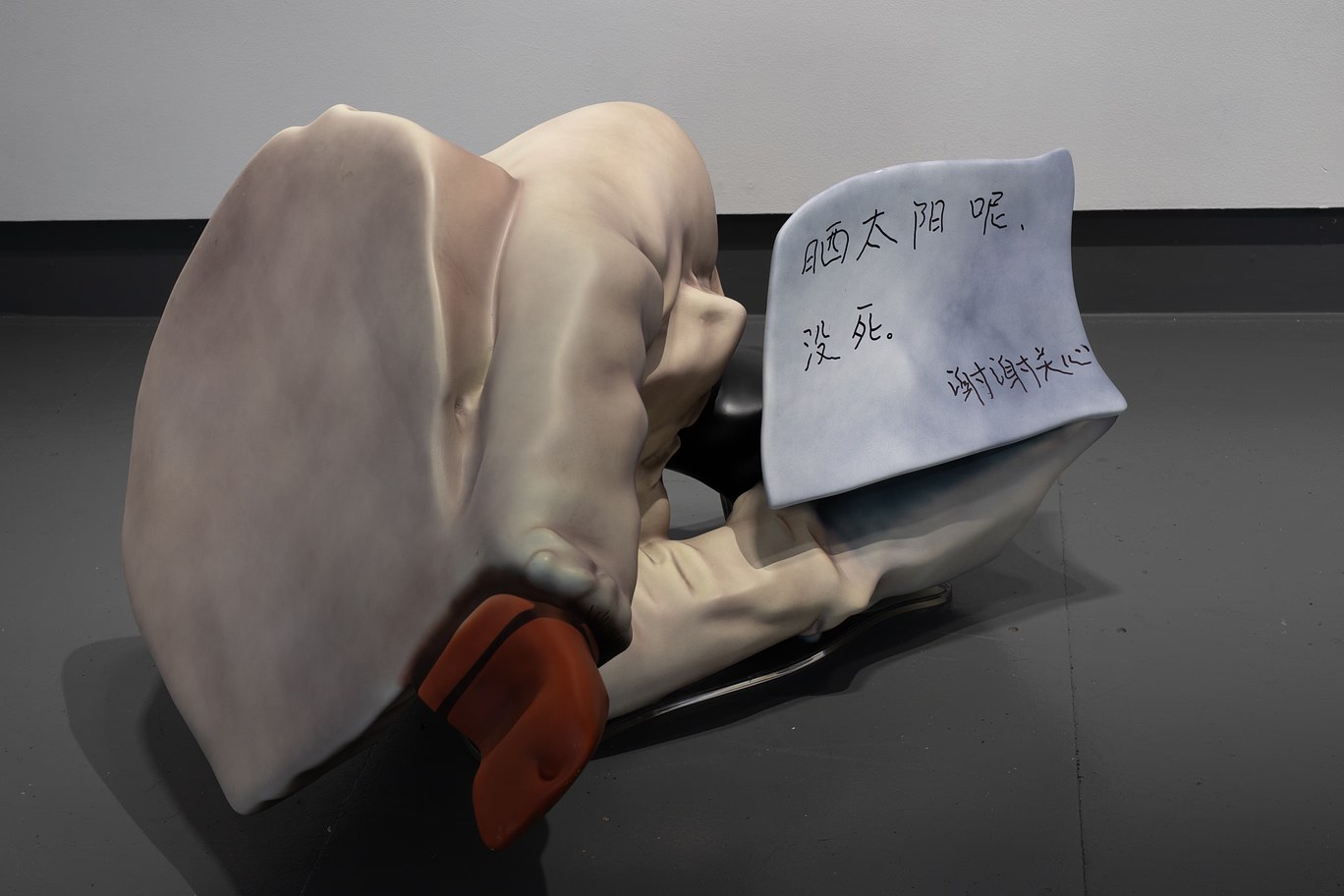
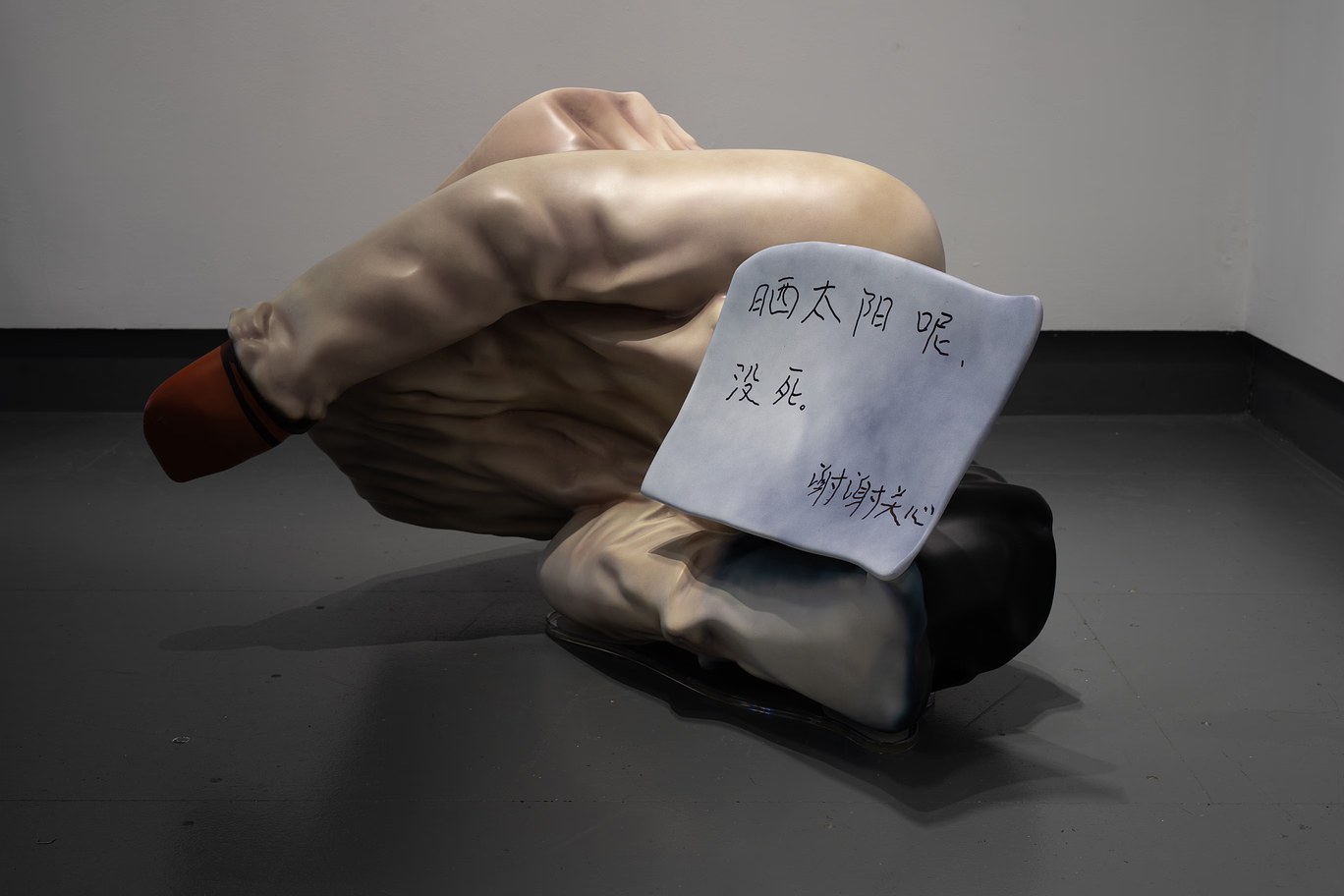
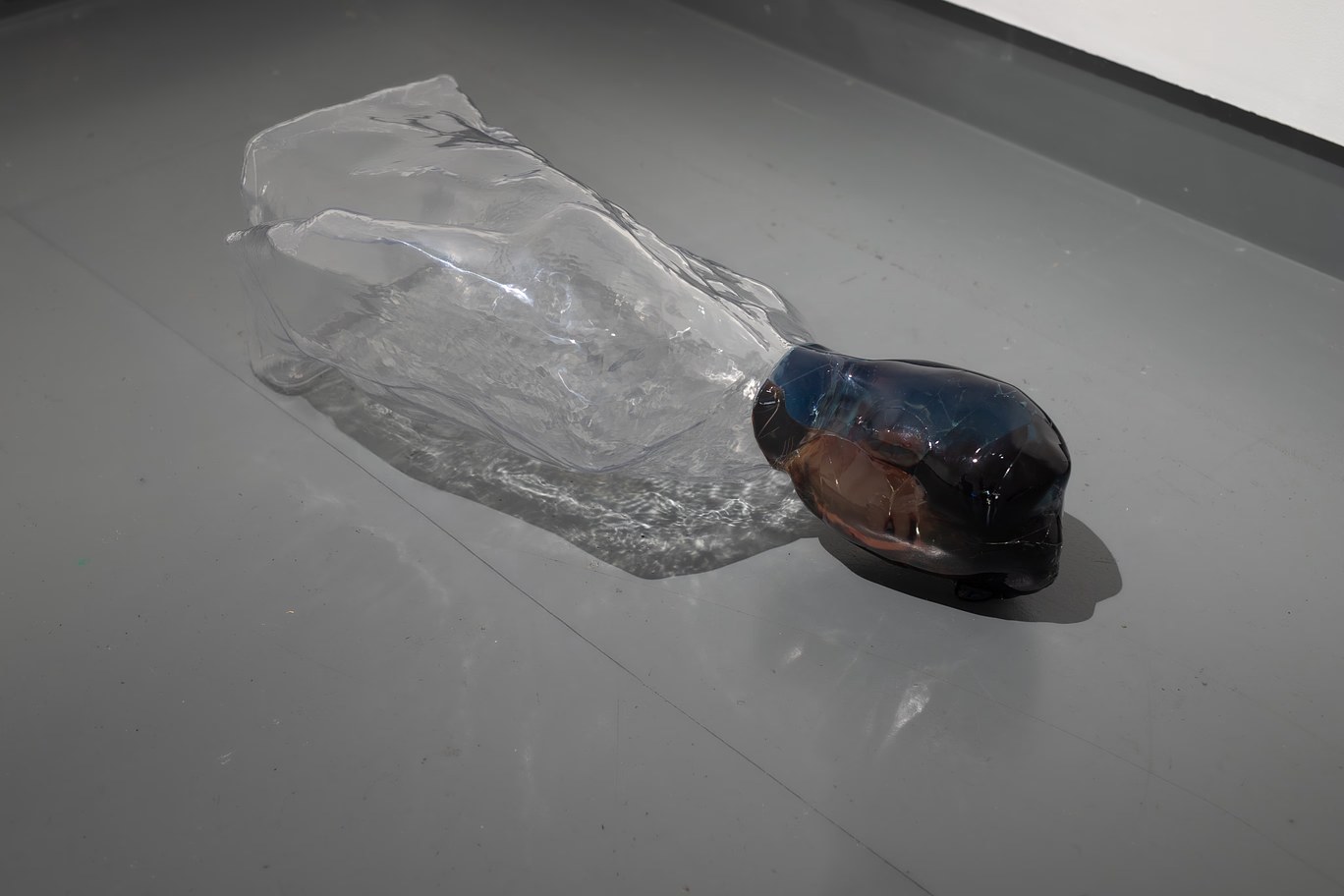
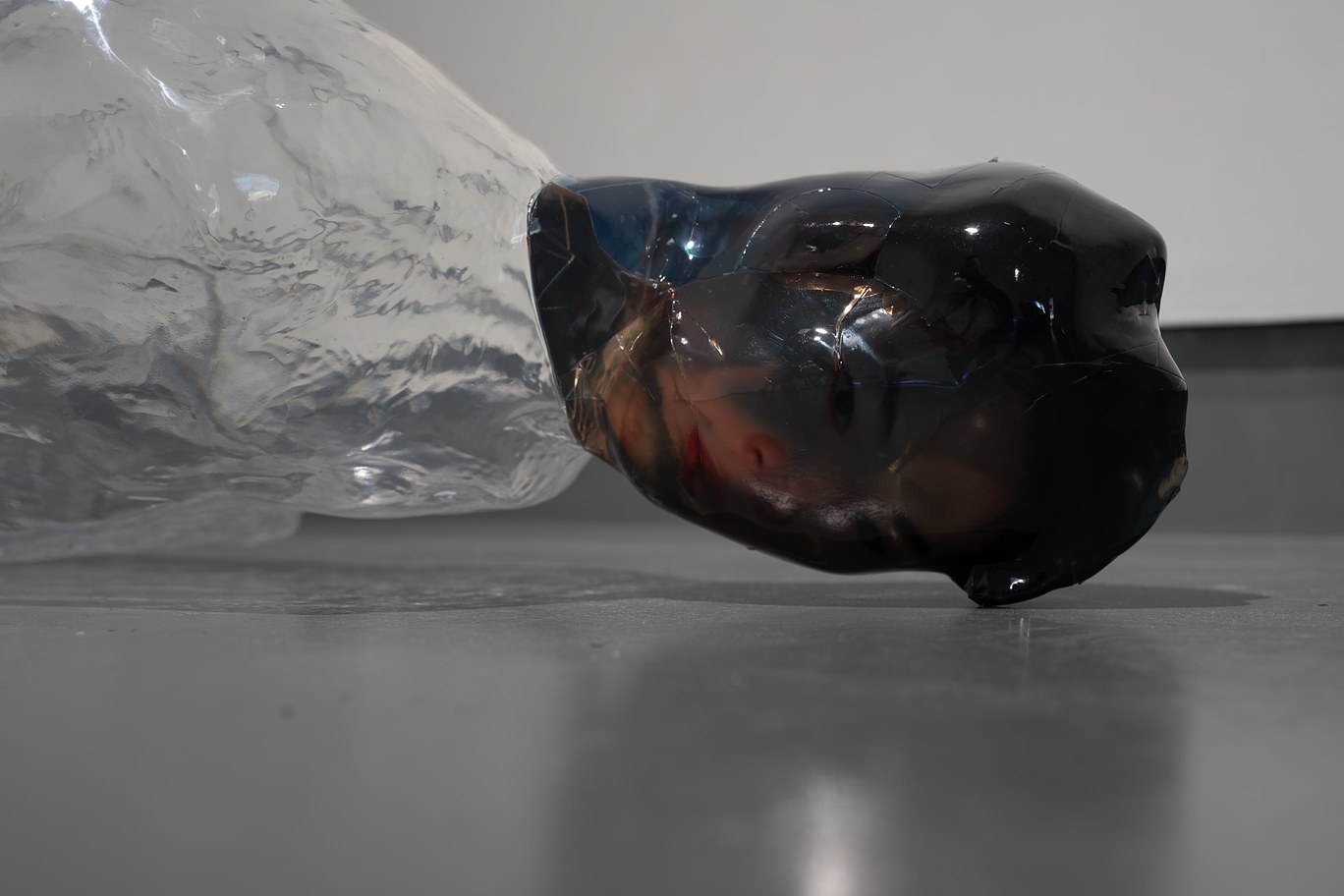
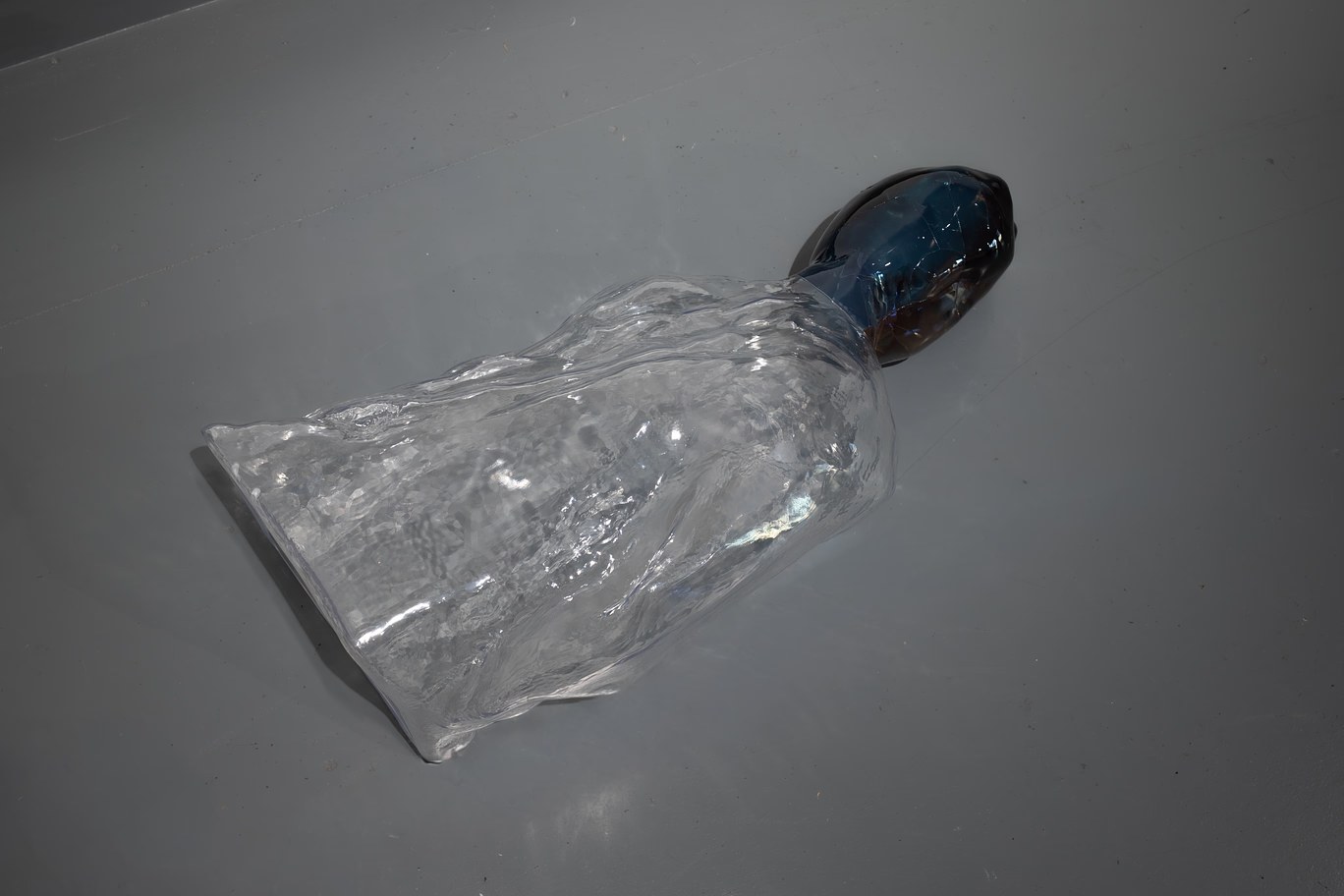
- Nobody (2024–2025; 3D transparent resin printing, printed car film, Glasurit paint). On an image-to-3D AI platform there is a public example labelled “Asian male”; whether its source image was also generated by AI is impossible to know. I printed it in transparent resin, then used a model-car decal technique to lay the head texture back onto the physical object. Left behind after testing, this sample has no name, only a label, like a lonely ID card.
- Absurd Reality Check (2025; rotating LED screen, 10-inch LED screen, digitally printed sewn doll). The doll is what remains of online images of the “jingshen xiaohuo” (a meme for flamboyant young men: pot-lid haircuts, beaded loafers, tight outfits) once AI has removed their facial features; the videos Two rituals and One ritual are cut from footage of livestreams, WeChat Moments and local rituals; One ritual ends on the estrangement that remains once the laughter is over and the crowd has gone. The footage in Two rituals comes from Ag, Sun Santo and Gongze; the dynamic type in One ritual was designed by Mog.
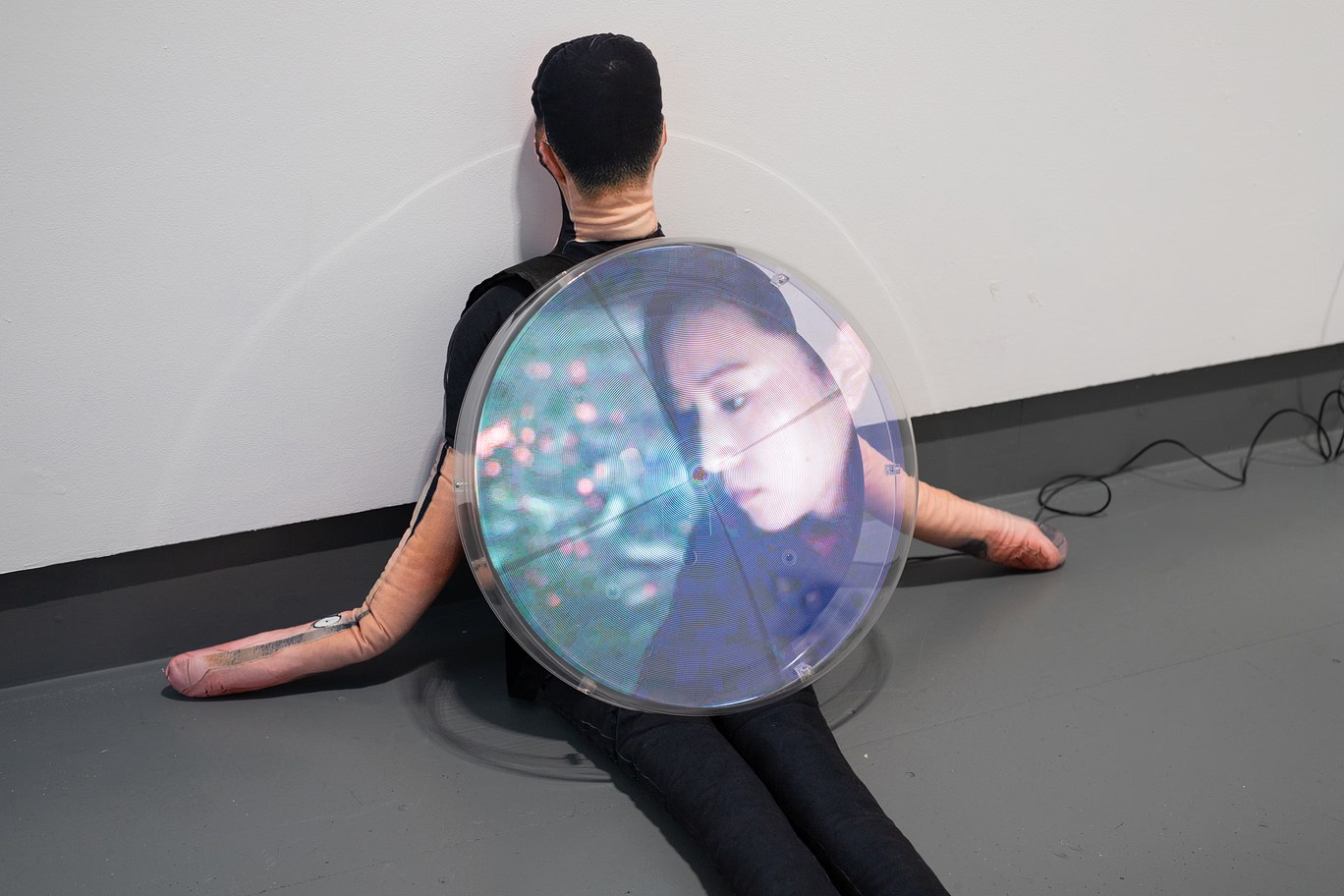
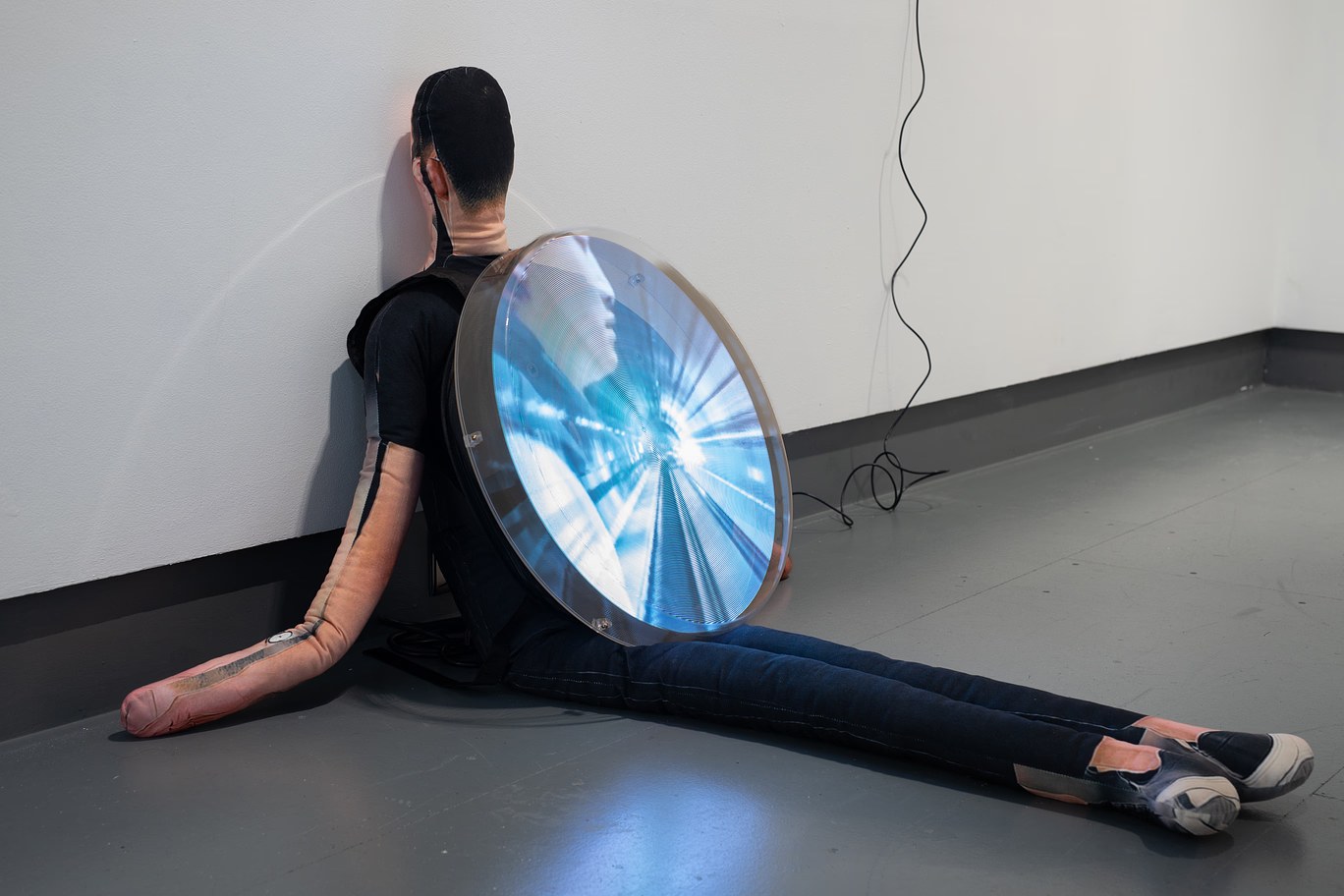
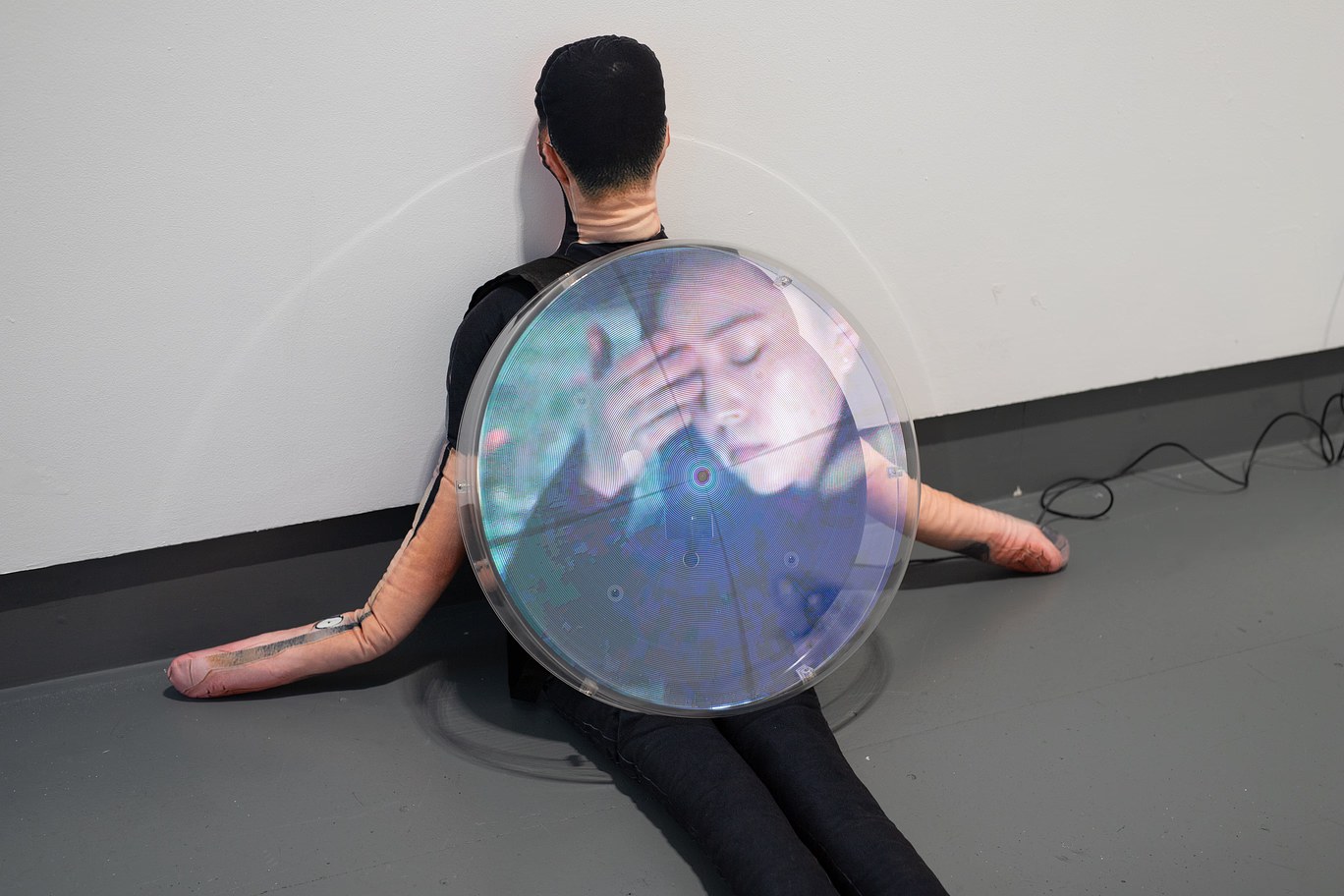
Here the Void is the “irreducibly human” that algorithms cannot reconstruct. The AI platform could not reconstruct the girl’s specific form; it left only a shape that is random yet still recognisable as “loneliness,” and the connections manufactured by recommendation systems cannot fill it. Nobody is the reverse: the sample is complete, and no name remains. With the two labels “Asian male” and “jingshen xiaohuo,” my target is the platform’s default samples and the way it presses images of groups into memes, not the people the labels refer to.
From here
The model judged people, and failed; the shape the failure left behind is the work itself. In the next work, judgment returns to the human side, and it happens under pressure: the craftsman’s judgment of material, the player dodging close to the bullets. The line of sight shifts too, from attention to matter: to the factories, logistics and duty-free thresholds organised by algorithms and platform pricing, where AI is almost invisible.
The Eve of Parasitism
Four-screen spatial video installation with game footage, data visualisation and readymade artificial flowers
Project begun in 2015 through a collaboration with an acrylic factory in Shanghai; installation 2025–2027; in production
Project page (public Basecamp page): public.app.basecamp.com/p/k6yKZraevcGWrmqT8VvGwkEj
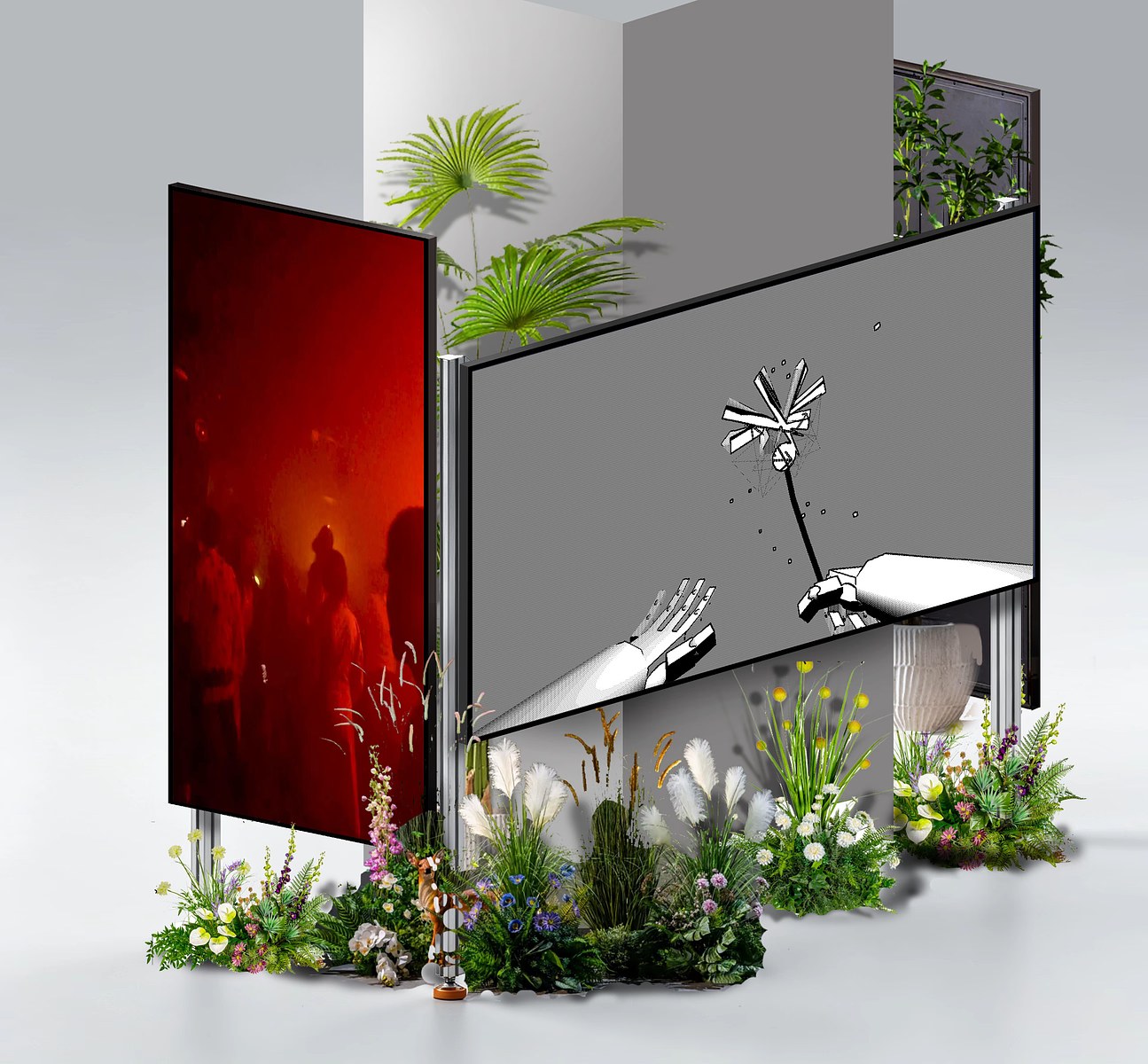
The Eve of Parasitism places the factory, the club, logistics and gaming in one field of perception: bodily technique, urban desire, platform interfaces and the rules of cross-border trade depend on one another, but never as equals. The language of “symbiosis” often masks this asymmetry; parasitism is not the opposite of symbiosis but the inequality hidden in its language.
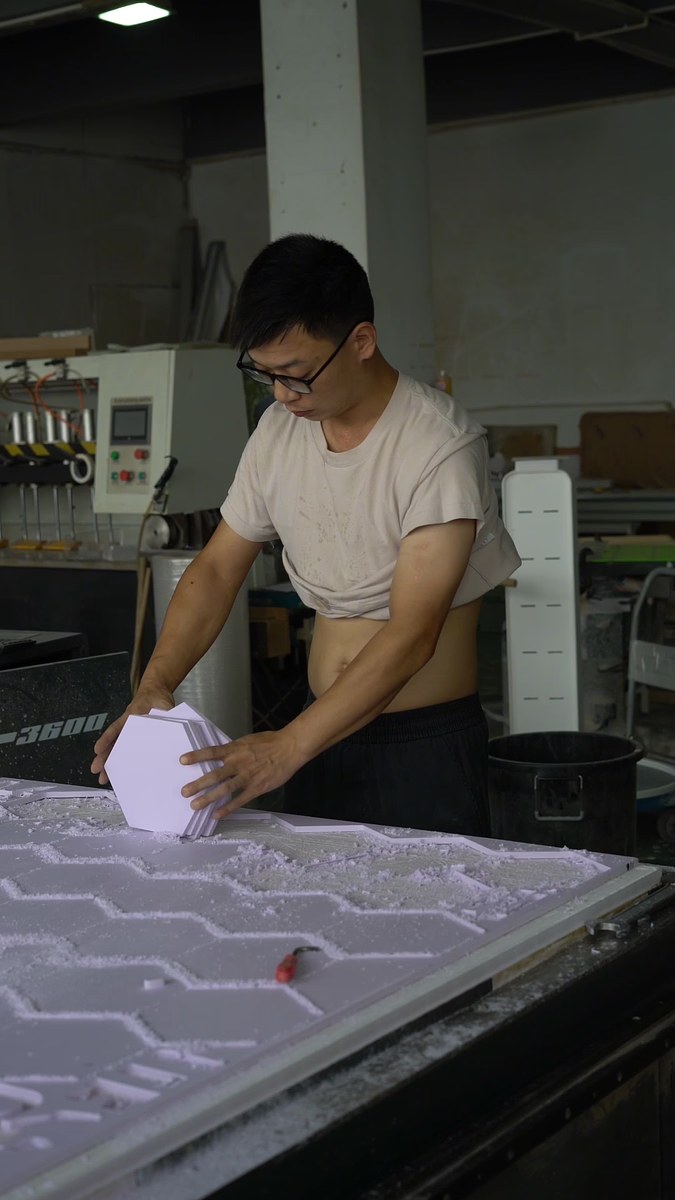
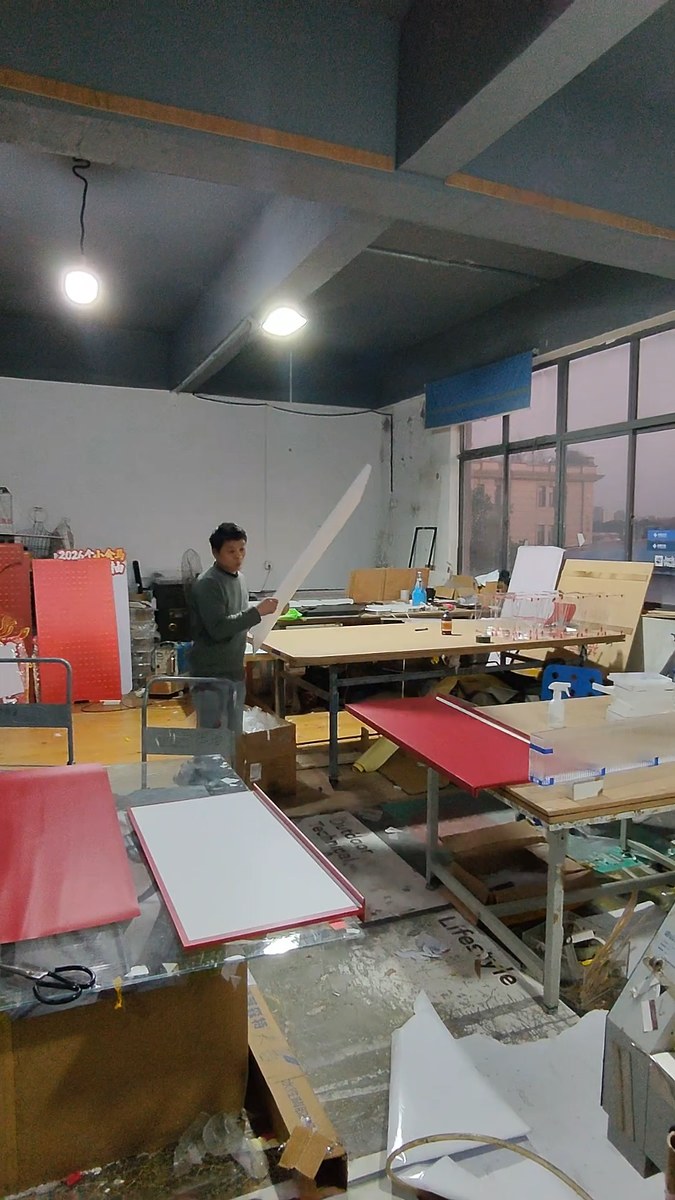
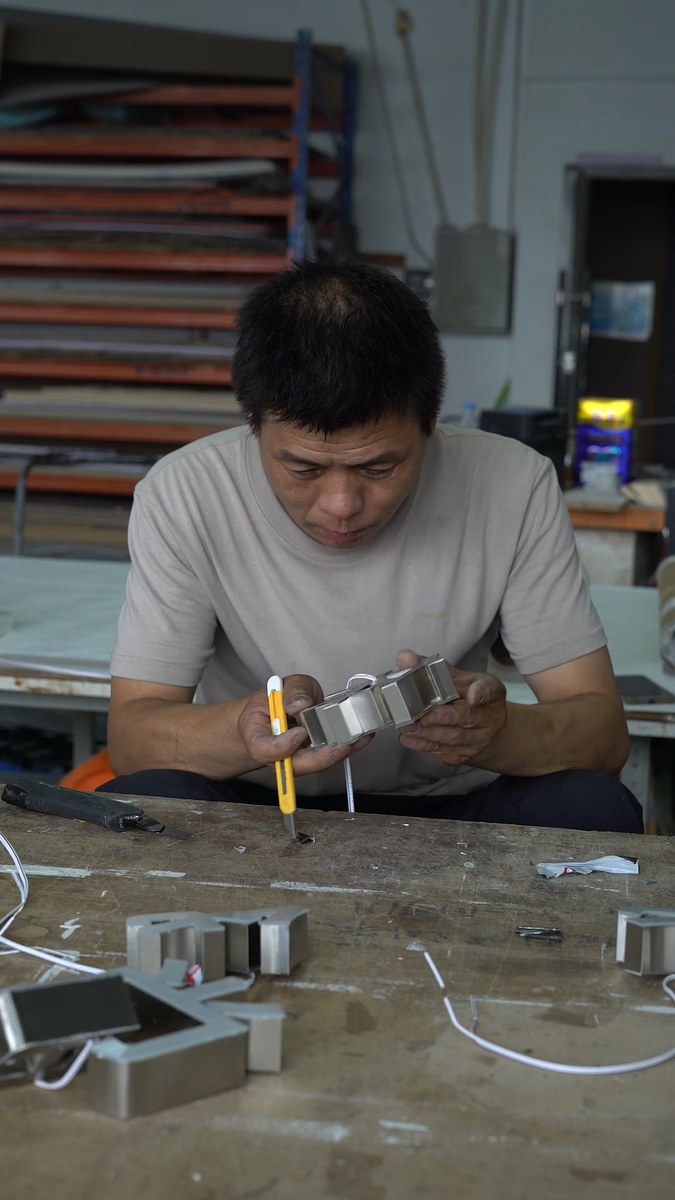
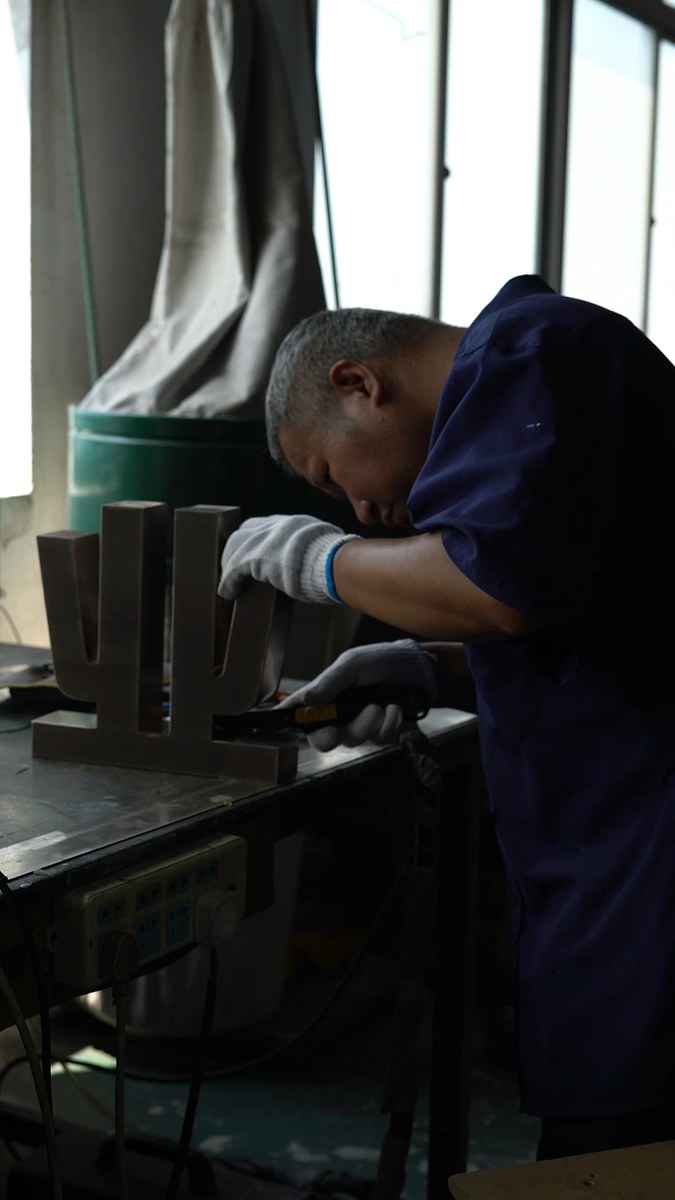
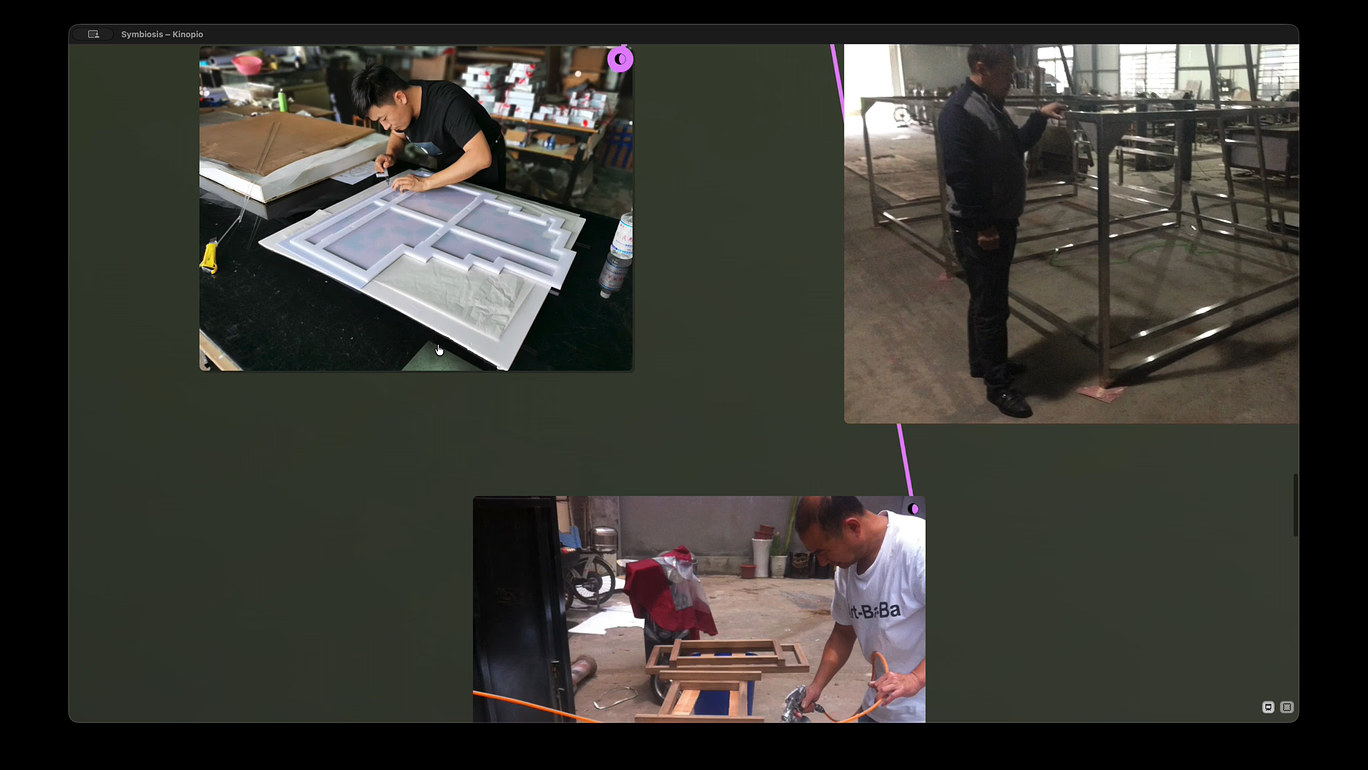
In the factory that houses my studio, the craftsman tests the temperature of the acrylic with the back of the hand, not a thermometer, relying on a memory that many years have left in the skin.
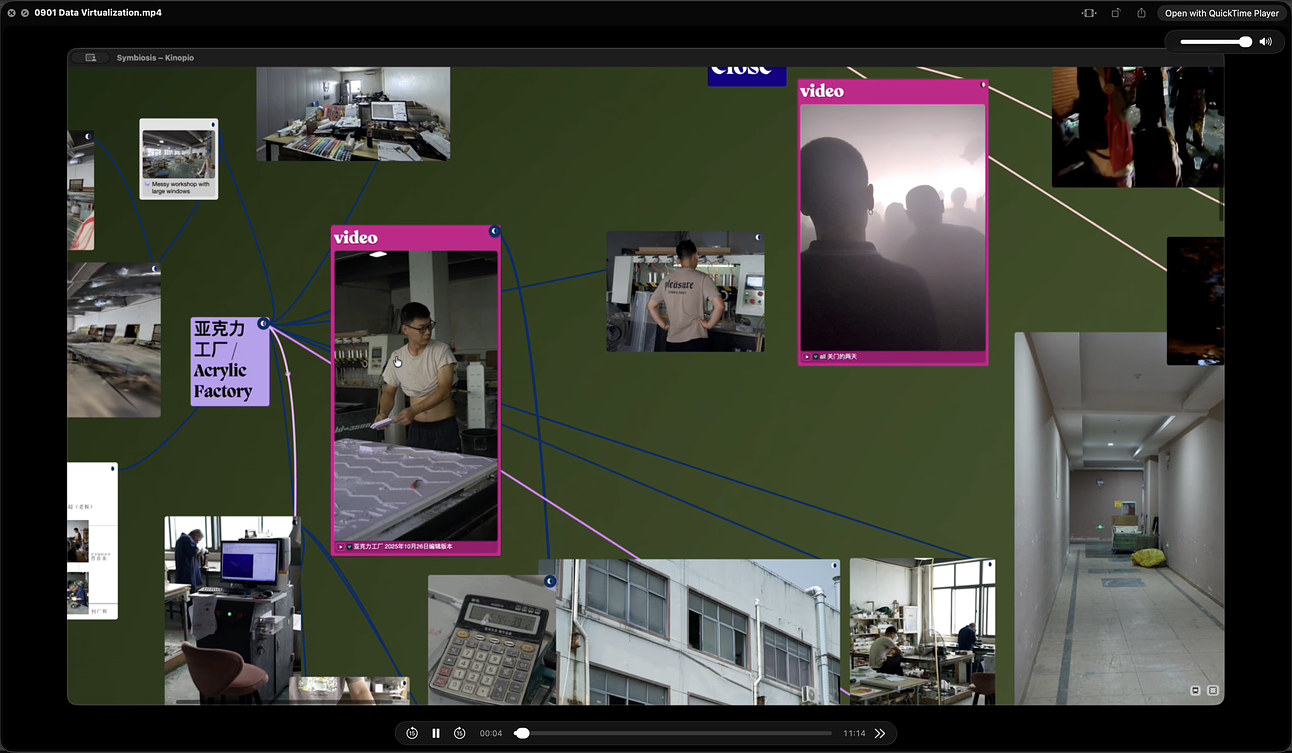
- Screen 1: Acrylic factory (31′25″; cinematography: Fan Shisan, Chen Guo; editing: aaajiao). The craftspeople’s judgments of temperature, friction, material resistance and the rhythm of the work cannot be fully reduced to working hours or output; I call this concentration Absorption (入神). The craftspeople and I share the same space, yet when it comes to class position, the knowledge we can reach and the future we can count on, we do not share the same fate; trust and fracture stay in the frame together.
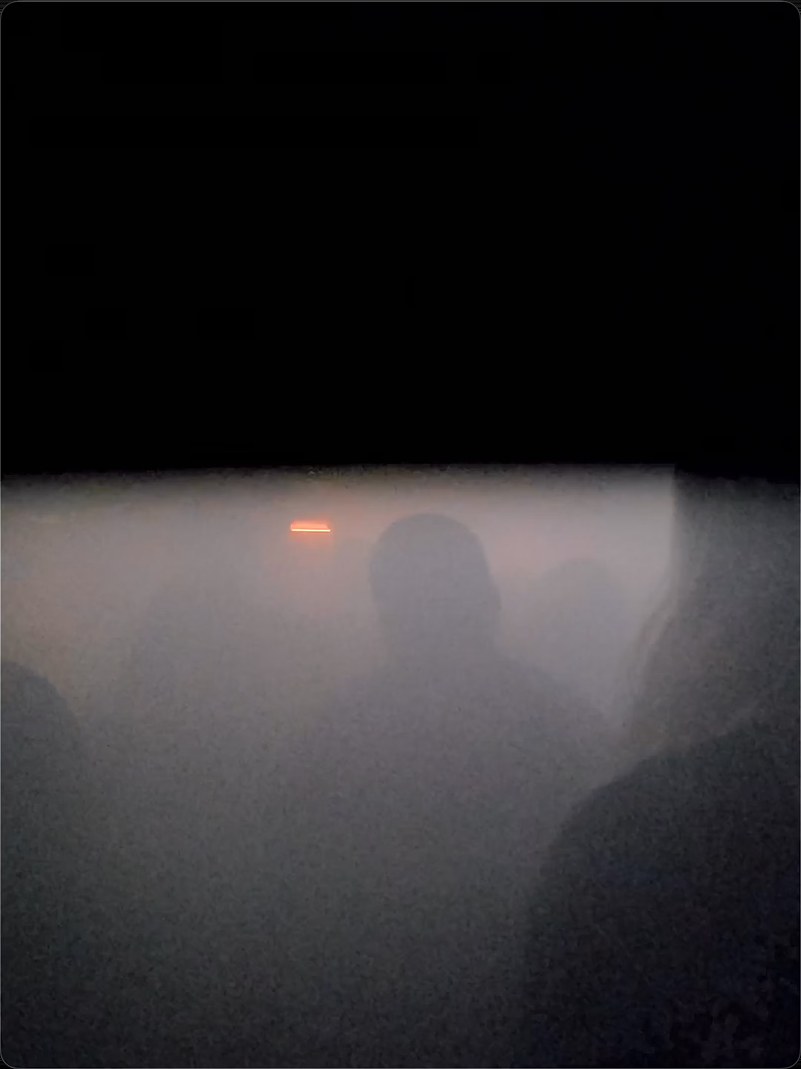
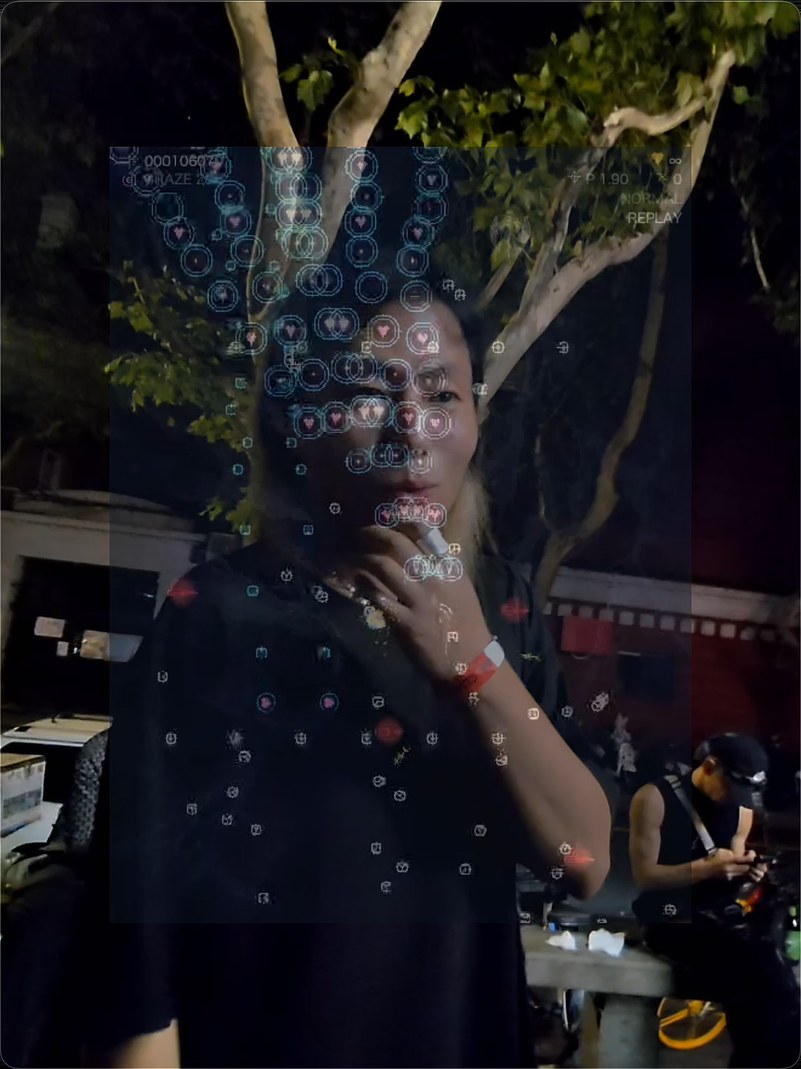
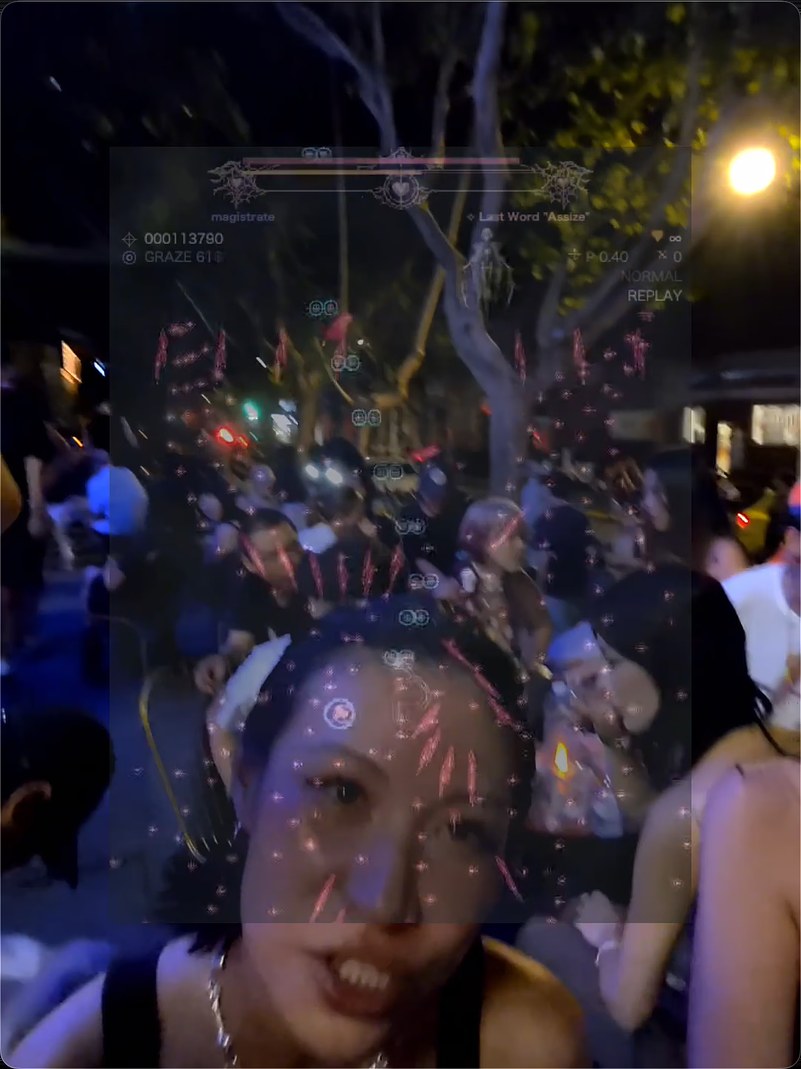
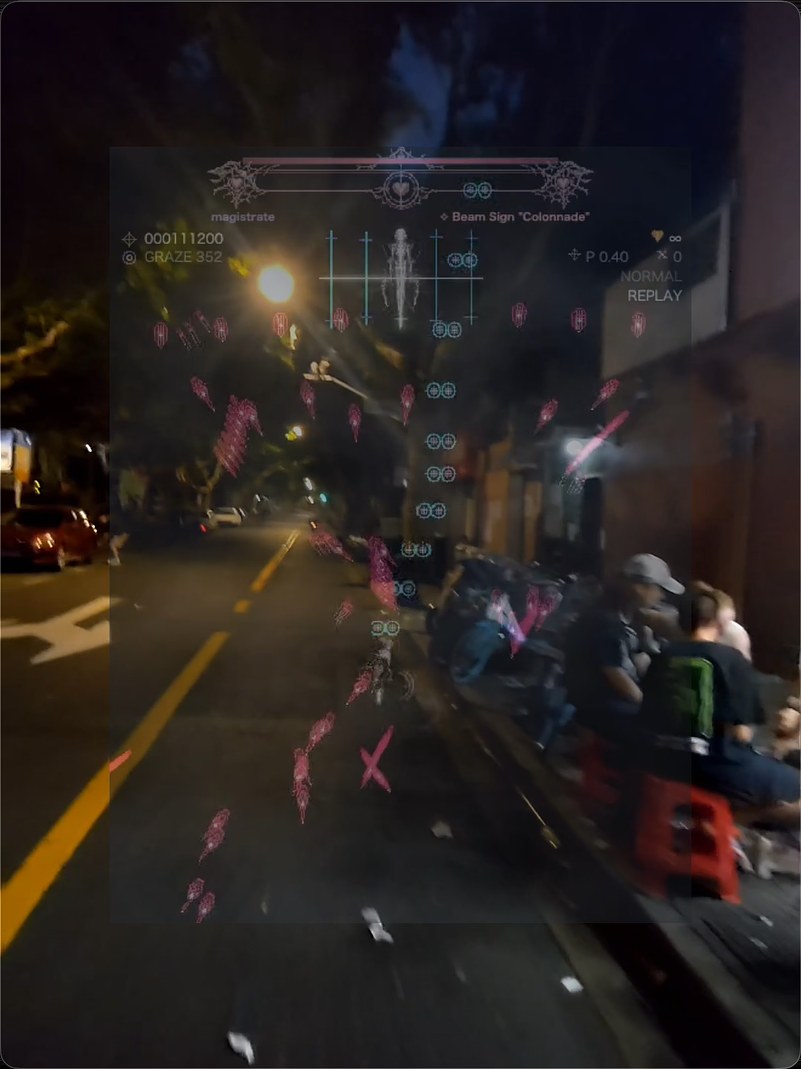
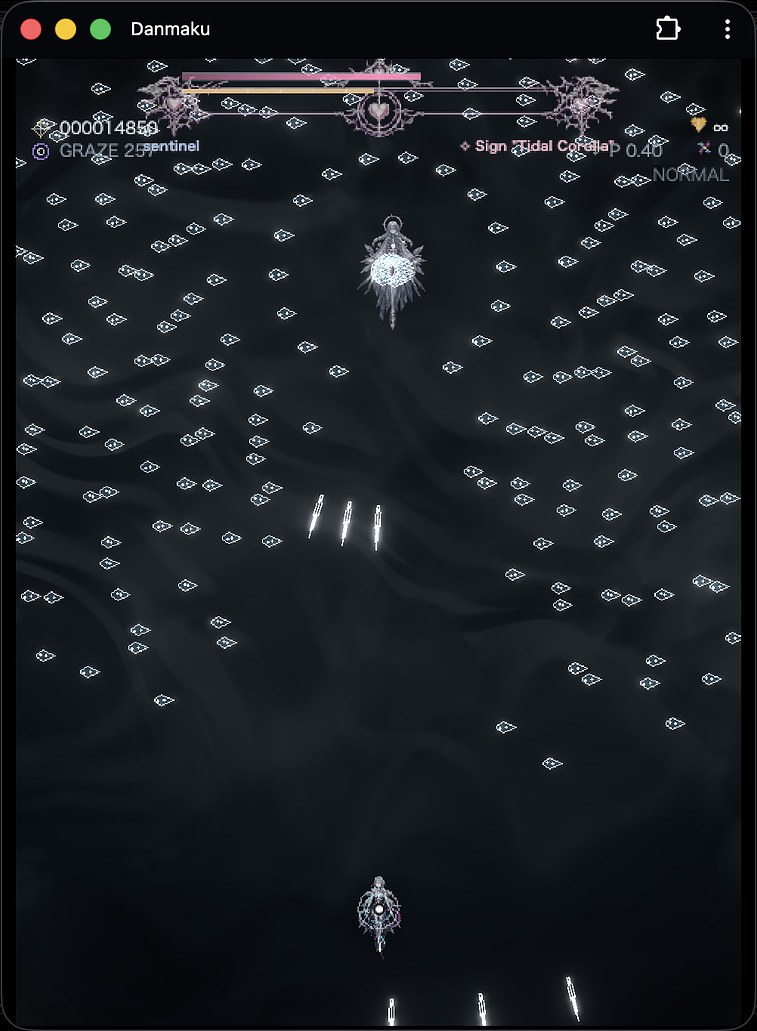
- Screen 2: ALL Close (12′14″; cinematography: Chen Guo; editing: aaajiao). Live footage from the last two days before the closure of ALL, Shanghai’s underground electronic-music club, is interwoven with imagery from the bullet-hell game Danmaku: The Negative-Space Ward (2026). On the dance floor, bodies form a temporary collectivity, and they also reveal the city’s dependence on young people’s energy, desire and consumption; the body on the dance floor, the person elsewhere: this is Trance (出神).
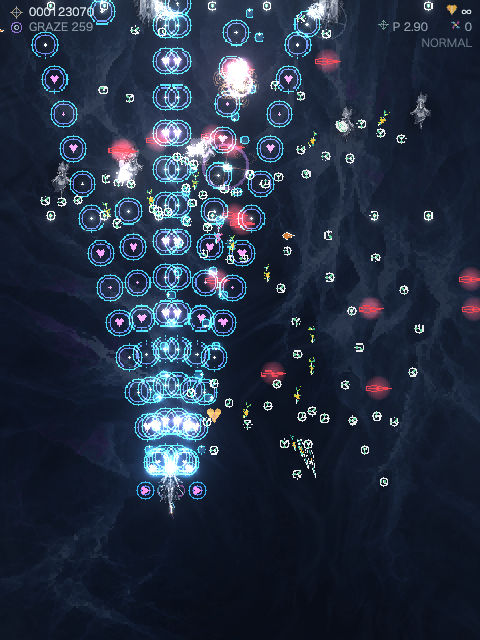
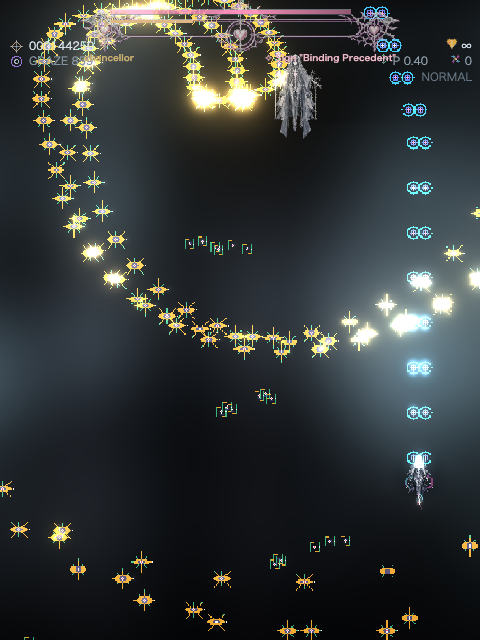
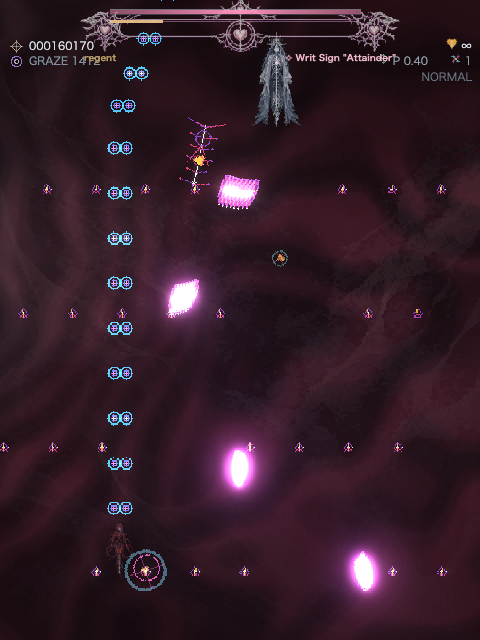
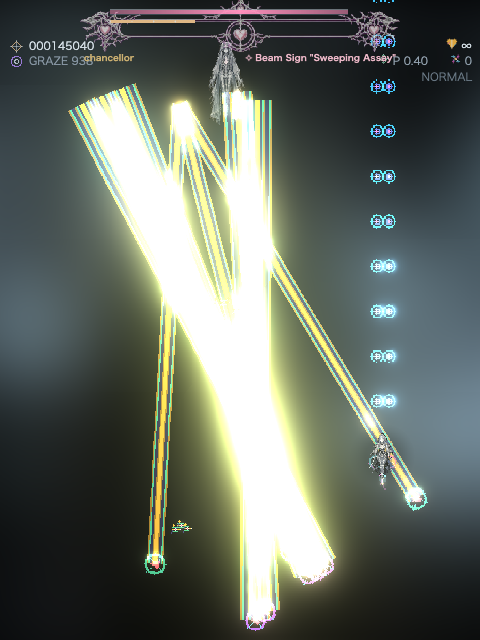
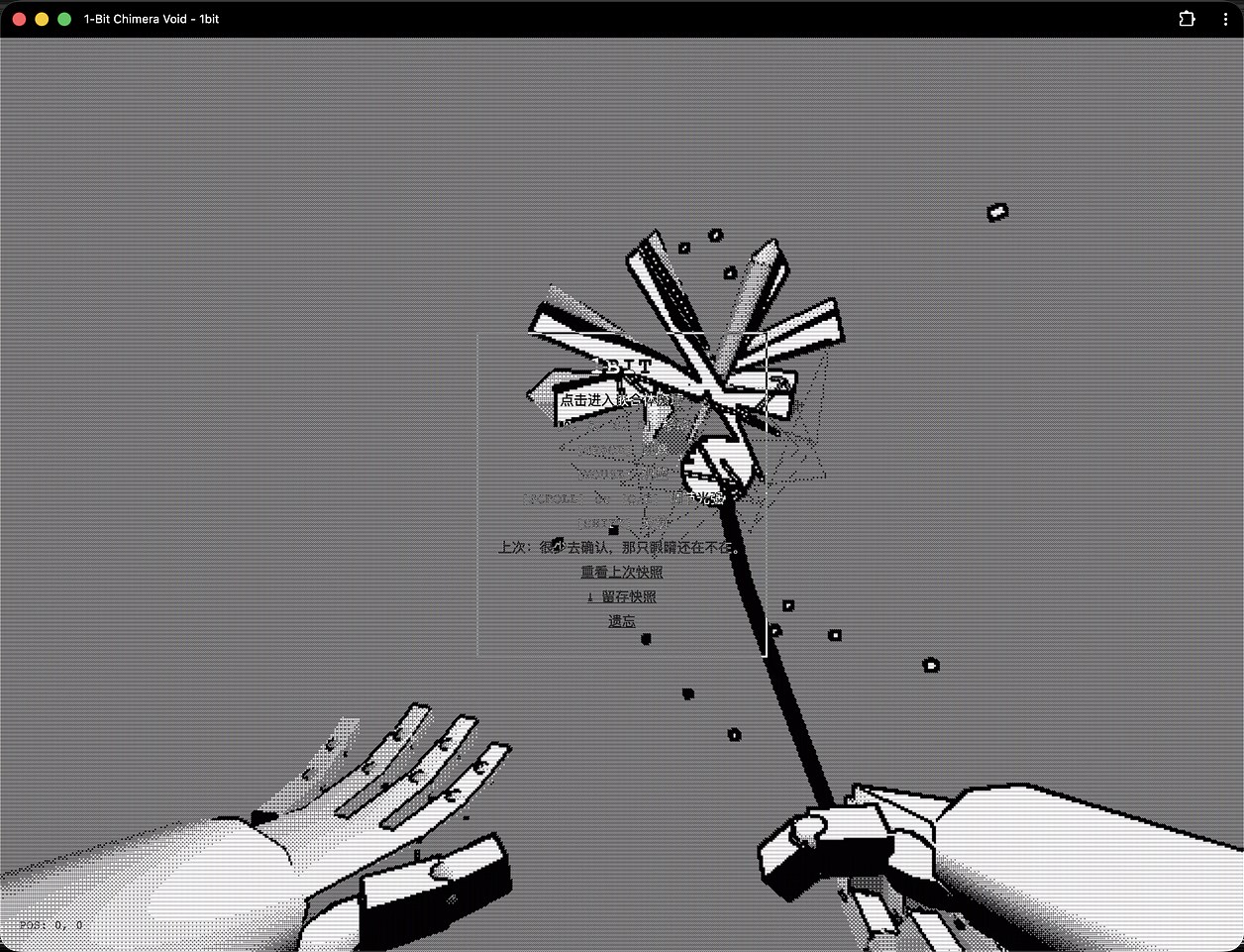
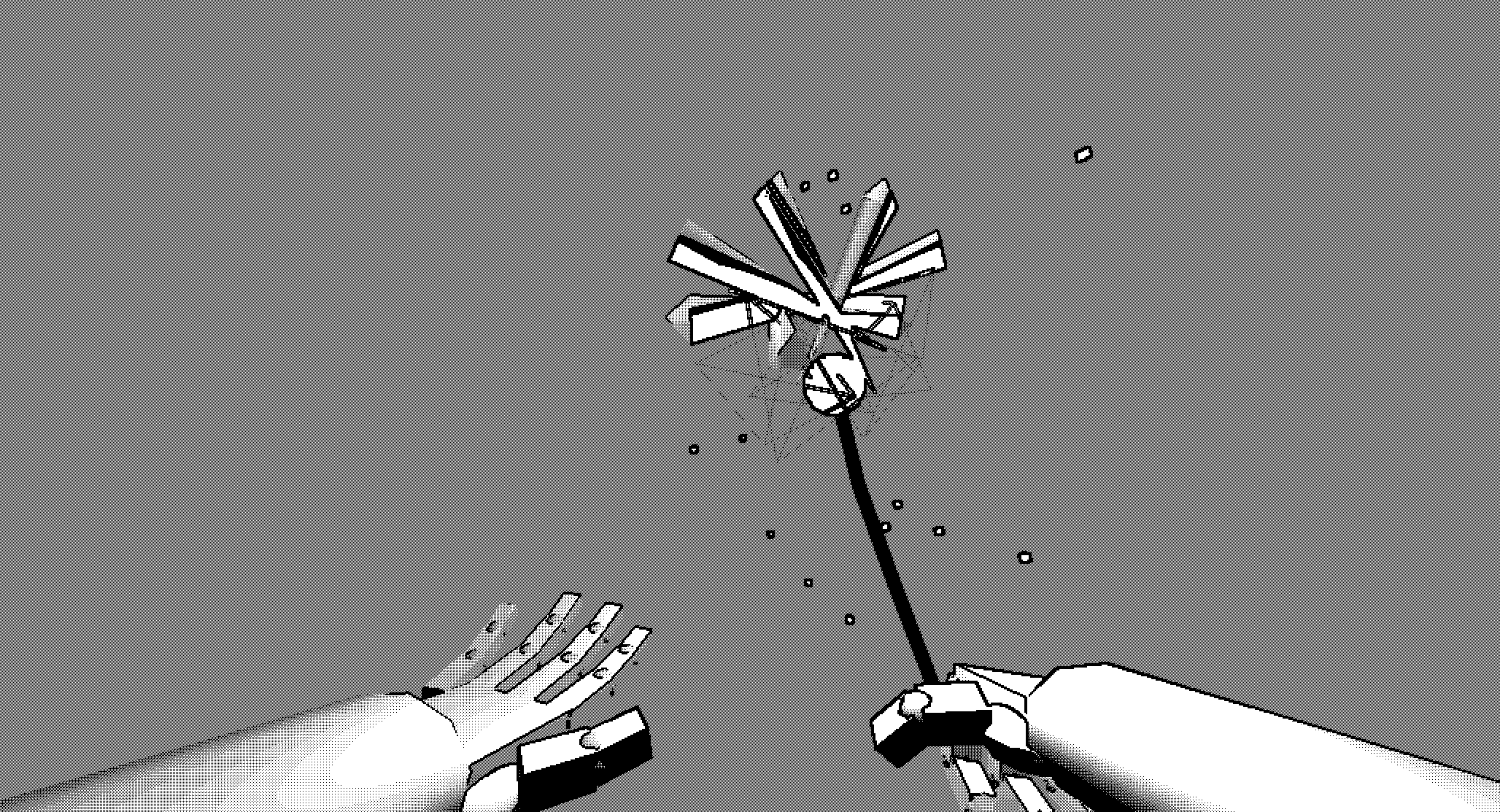
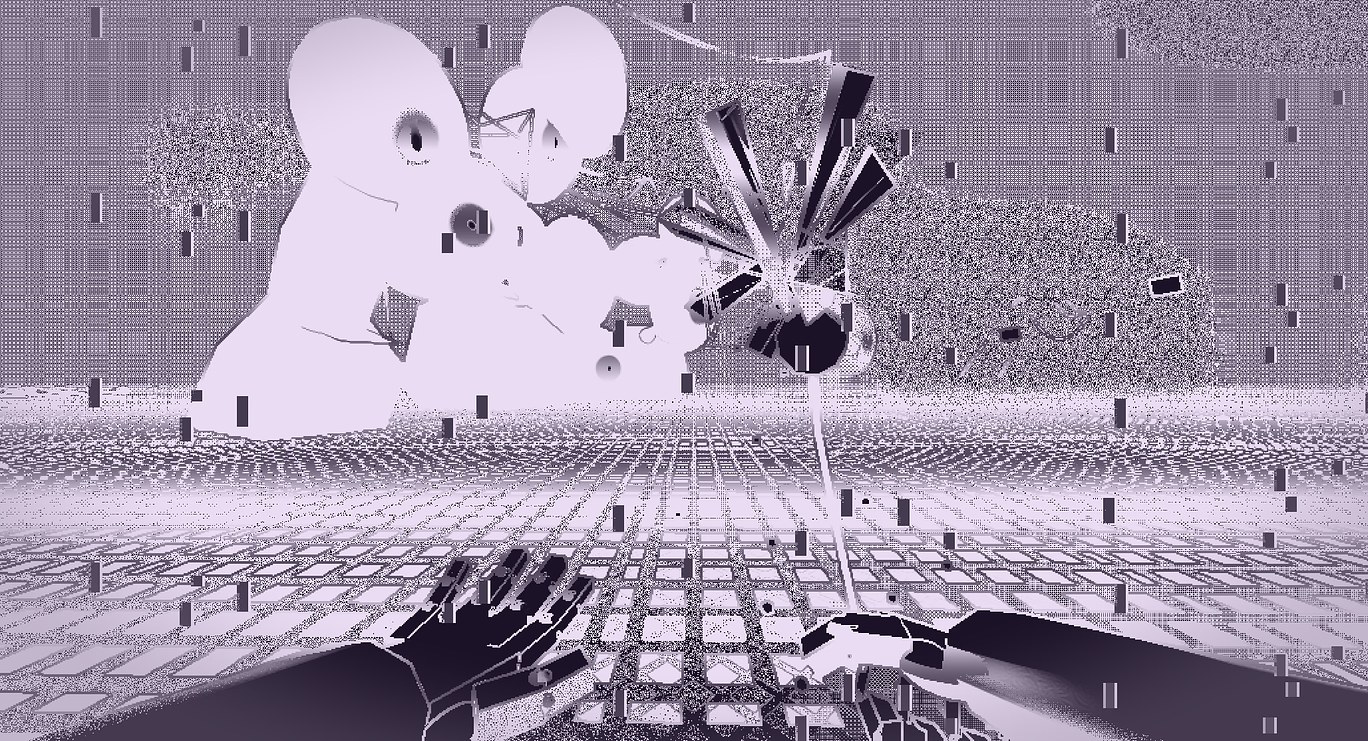
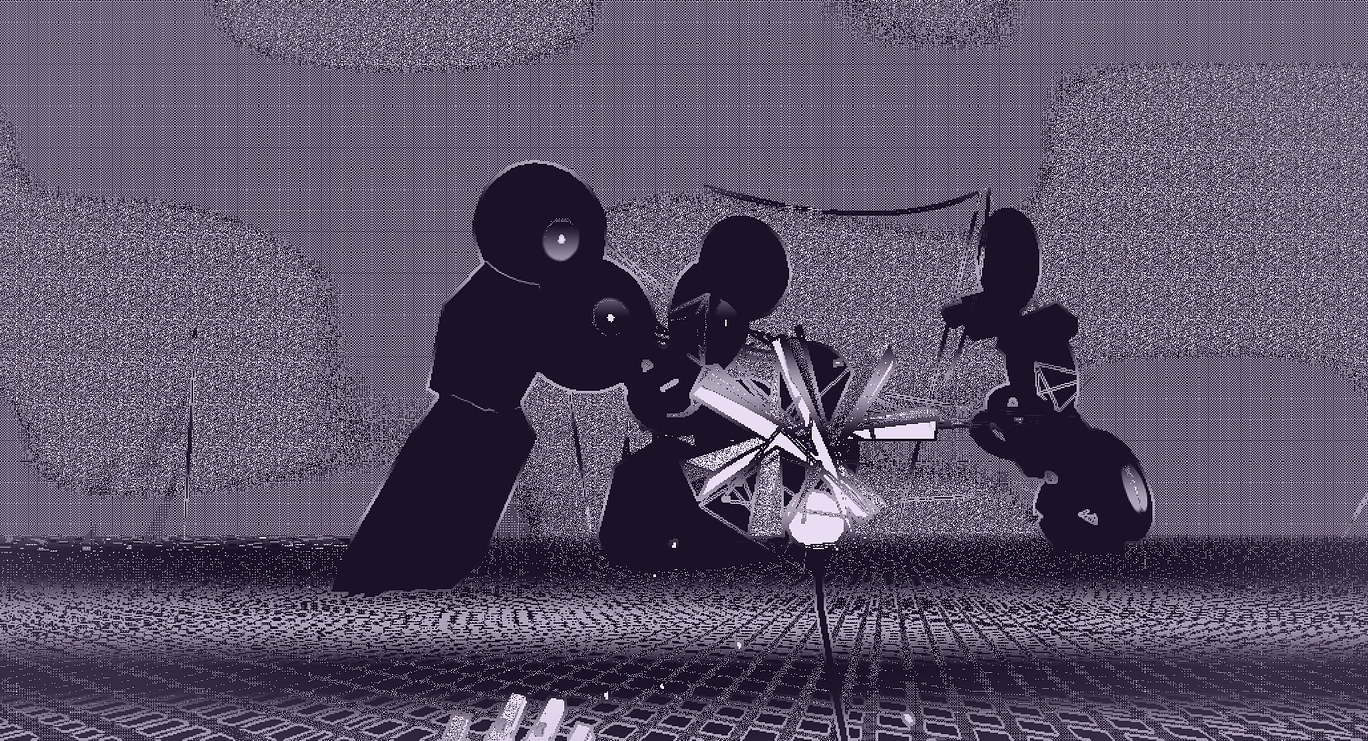
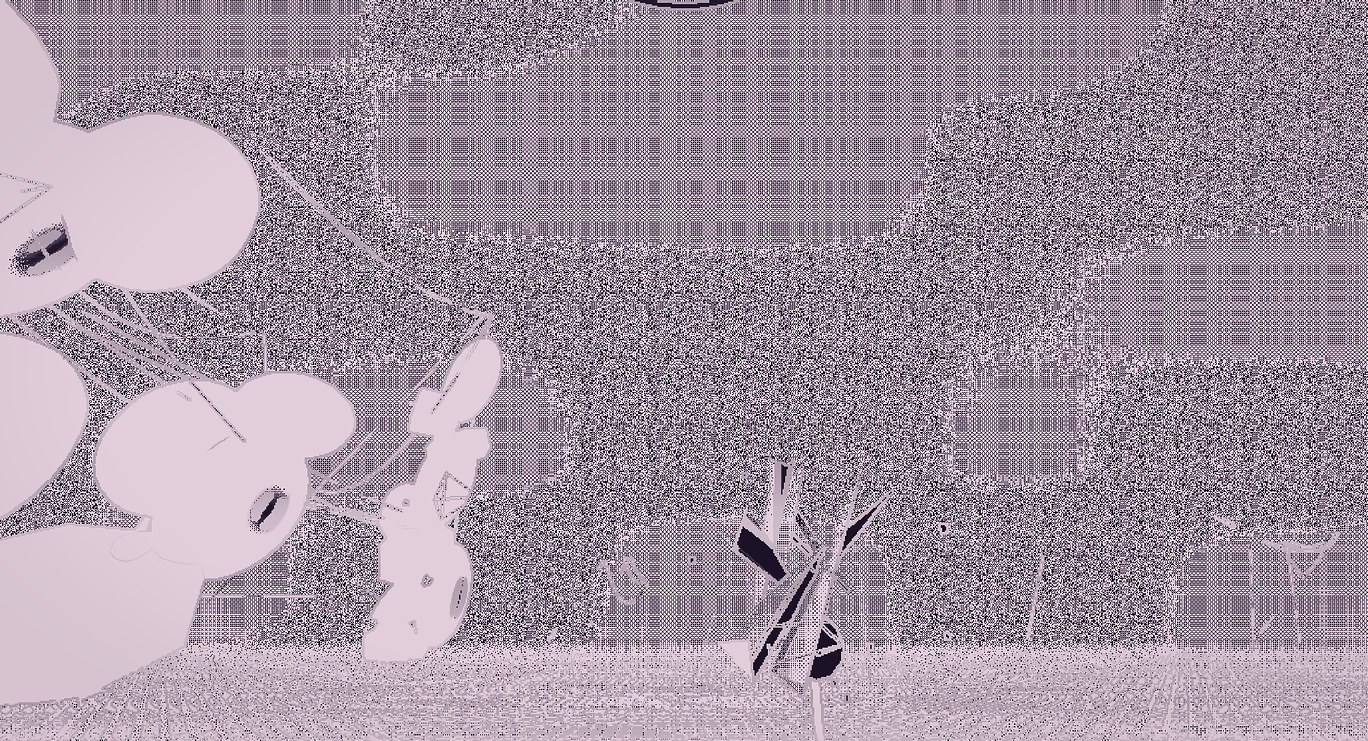
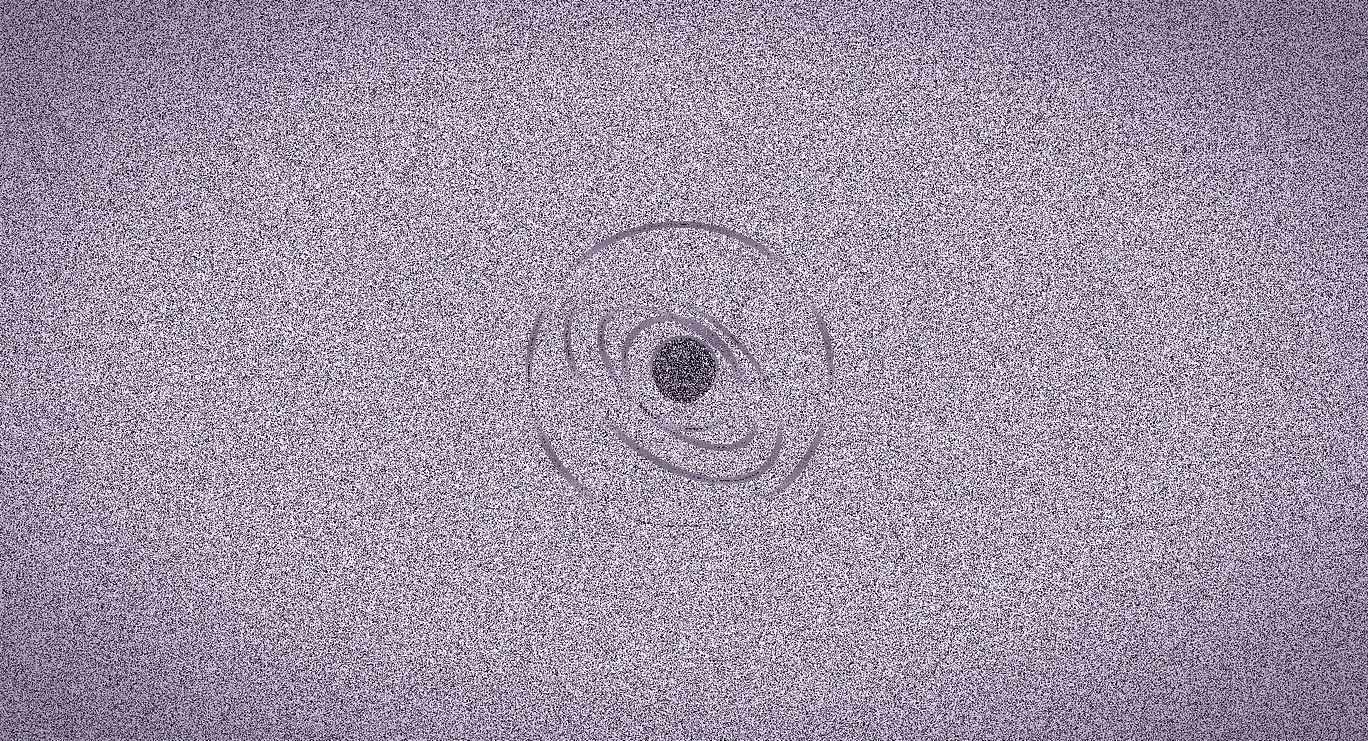
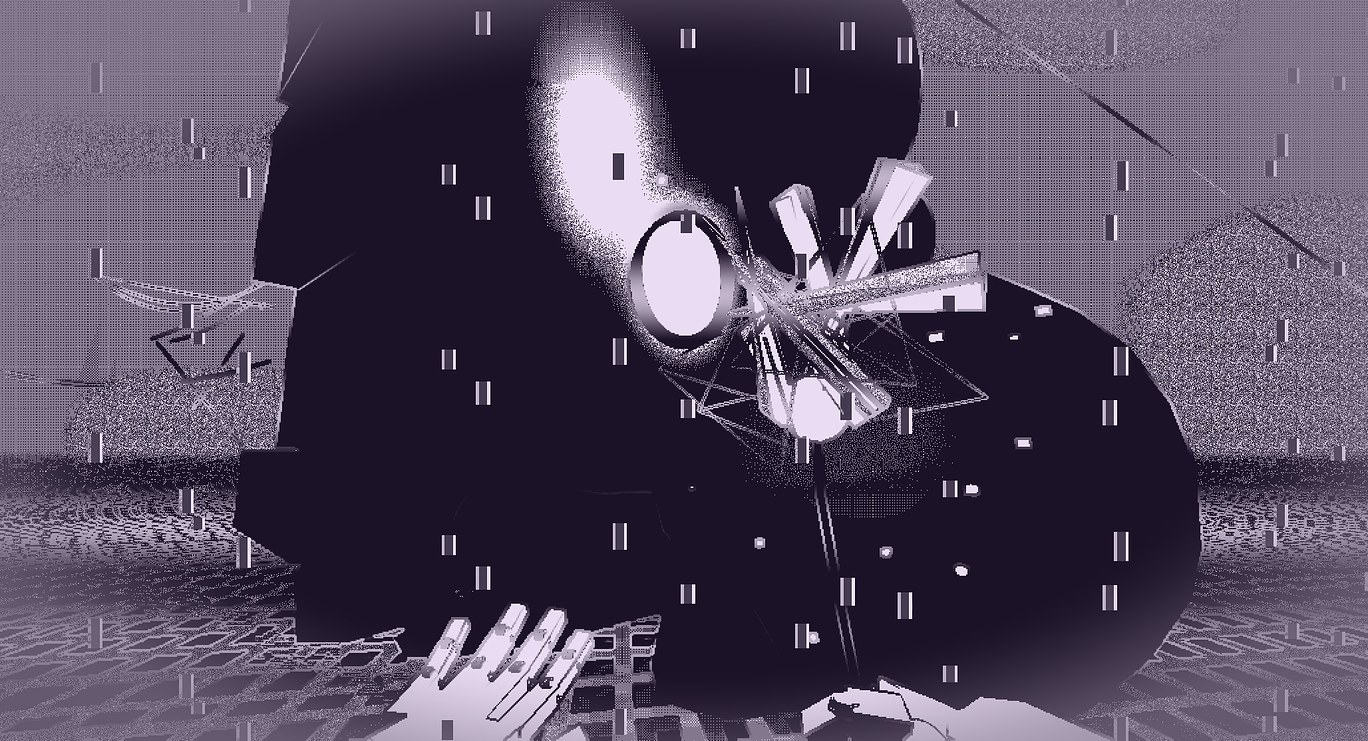
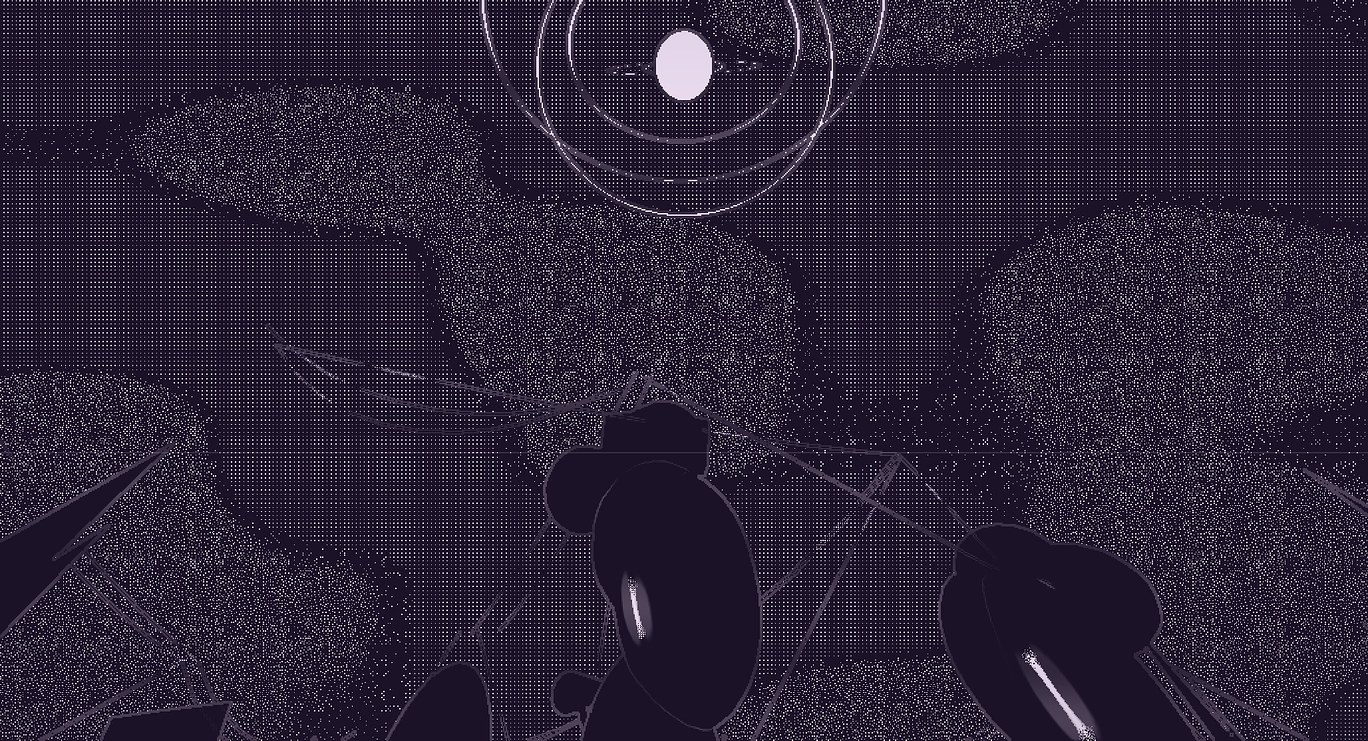
- Screen 3: 1bit (recorded gameplay, 11′09″). In procedurally generated hybrid ruins rendered in black-and-white 1-bit dithering, the player, holding a glowing flower, passes through, gazes, comes under pressure, and also resists.
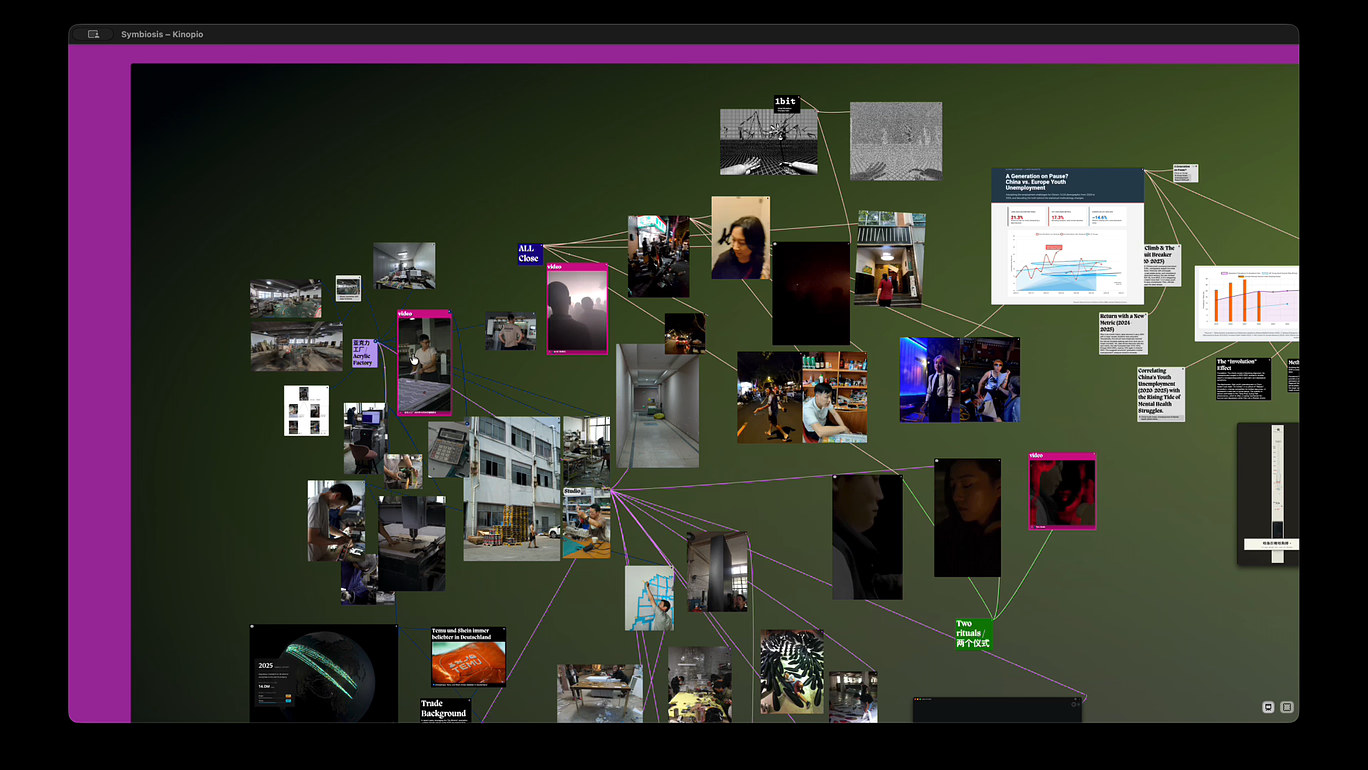
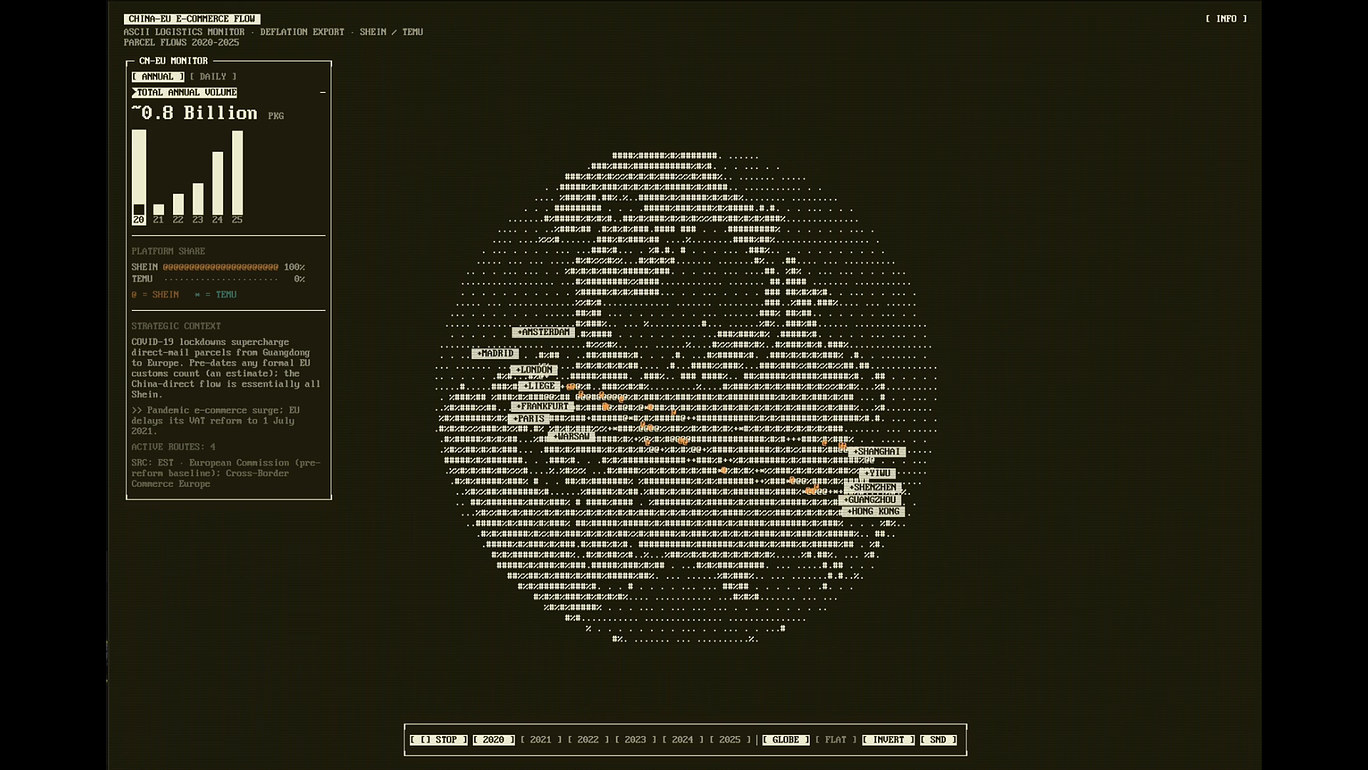
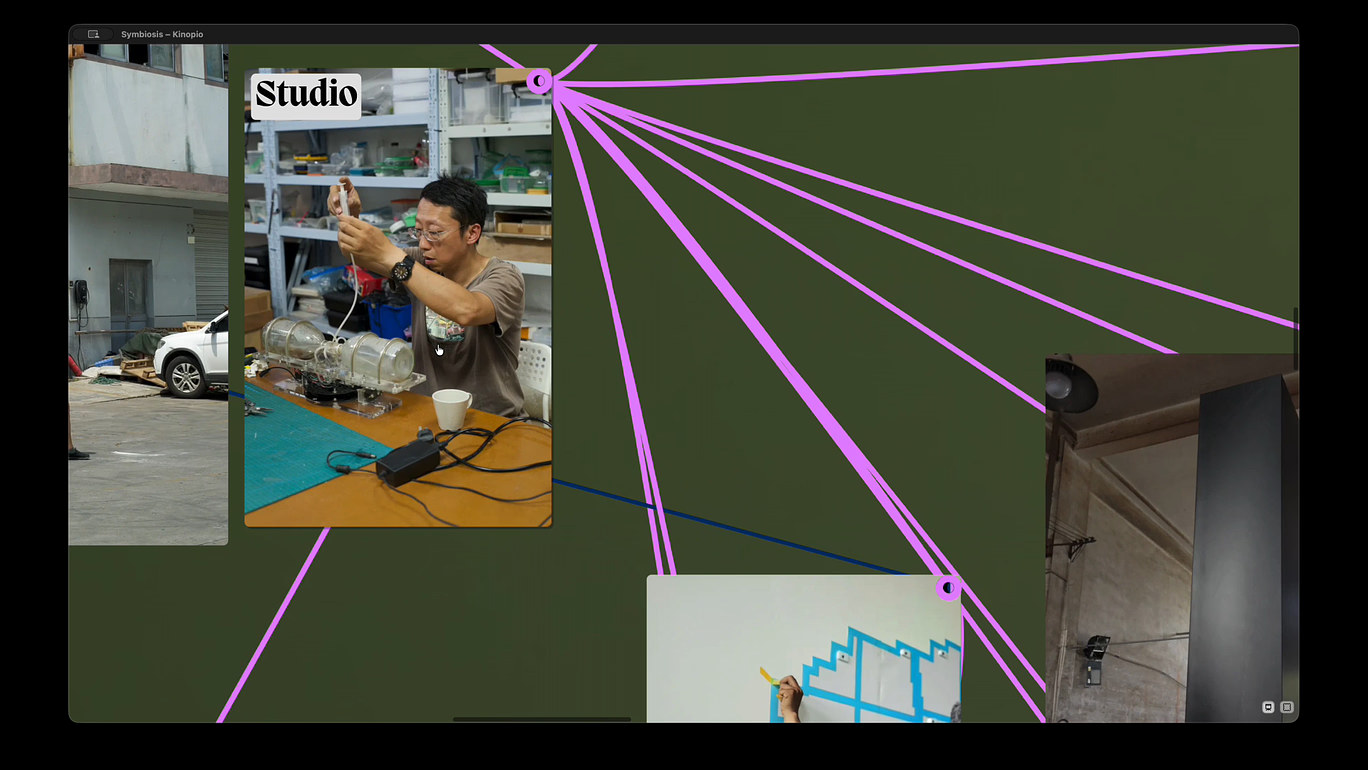
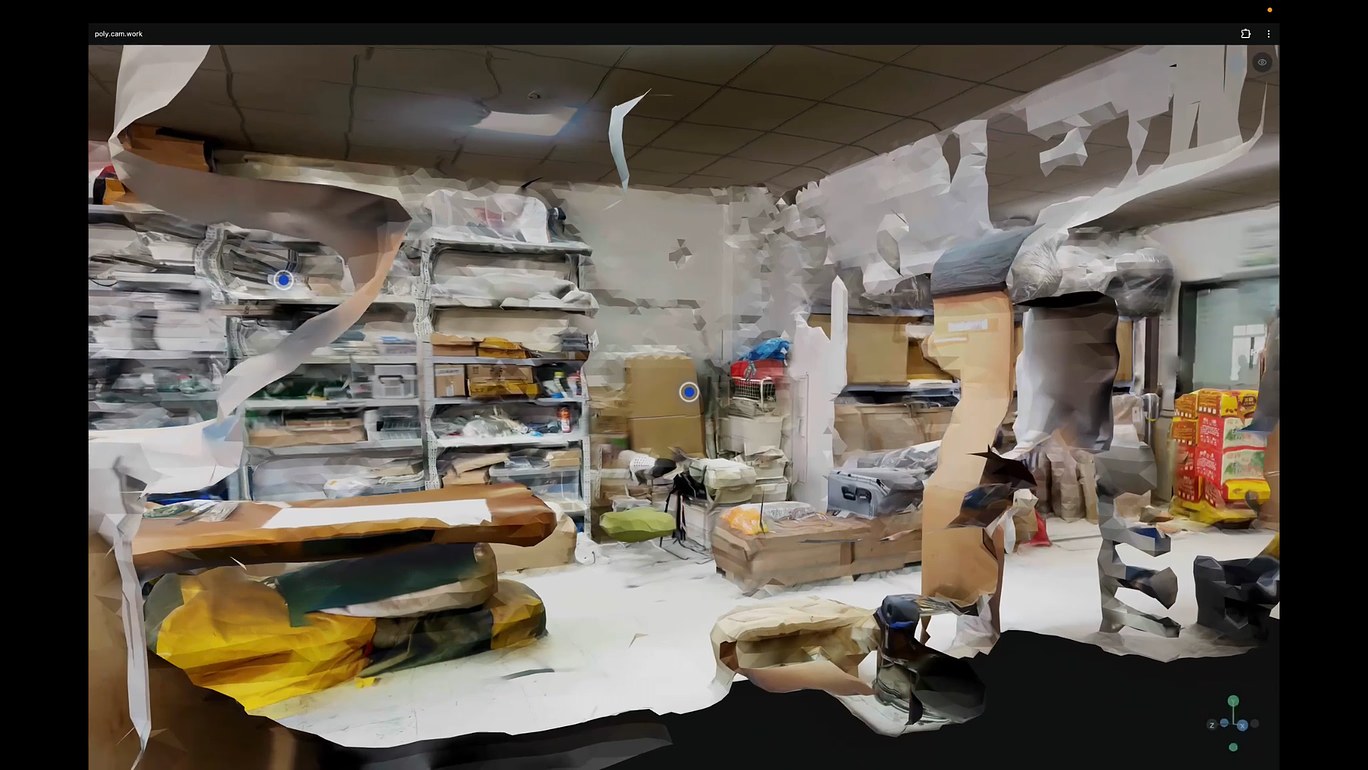
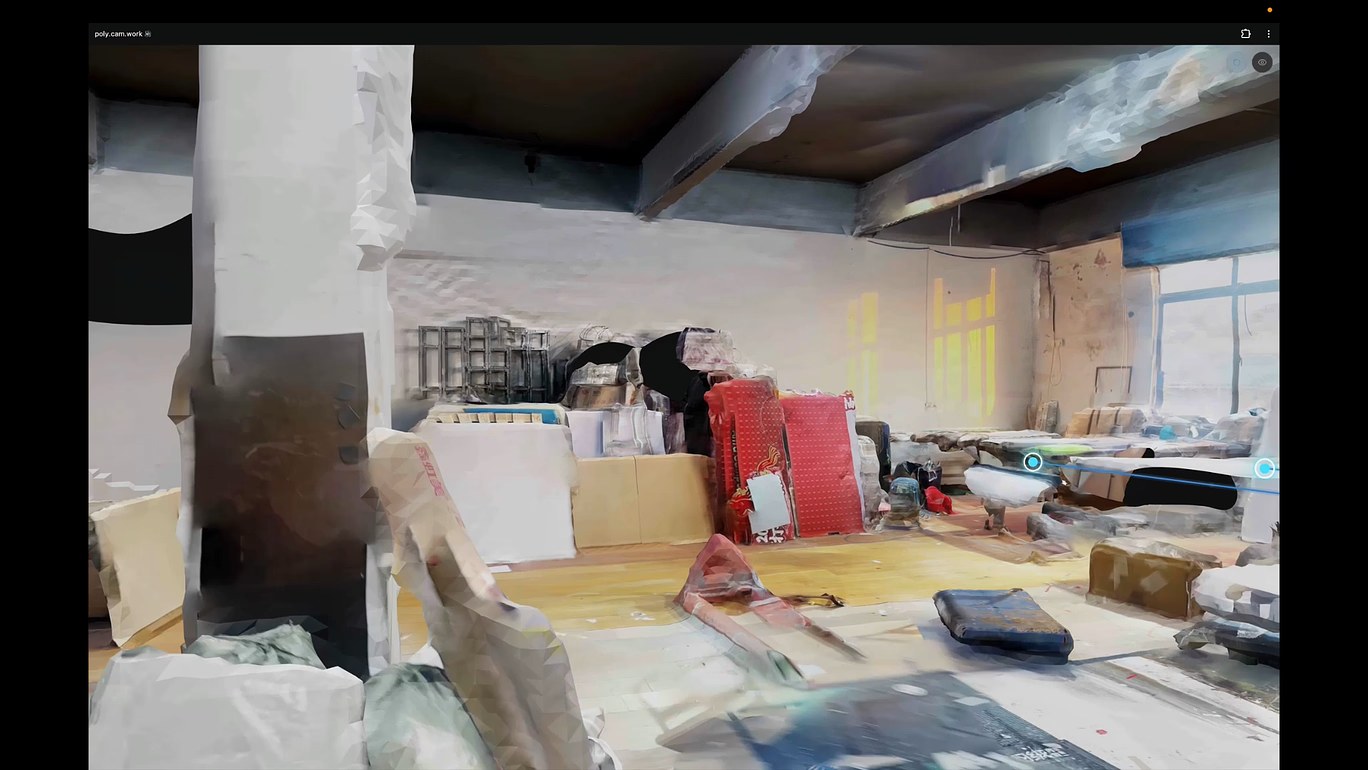
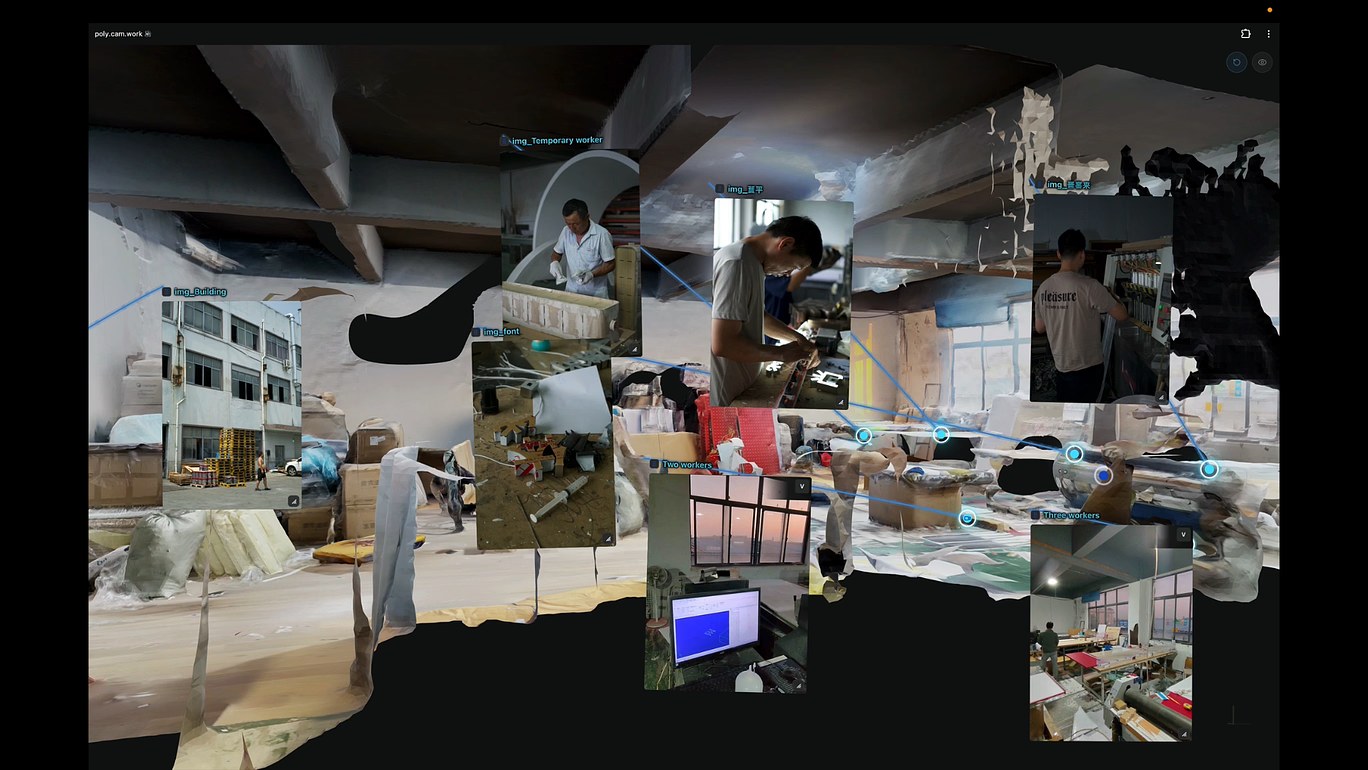
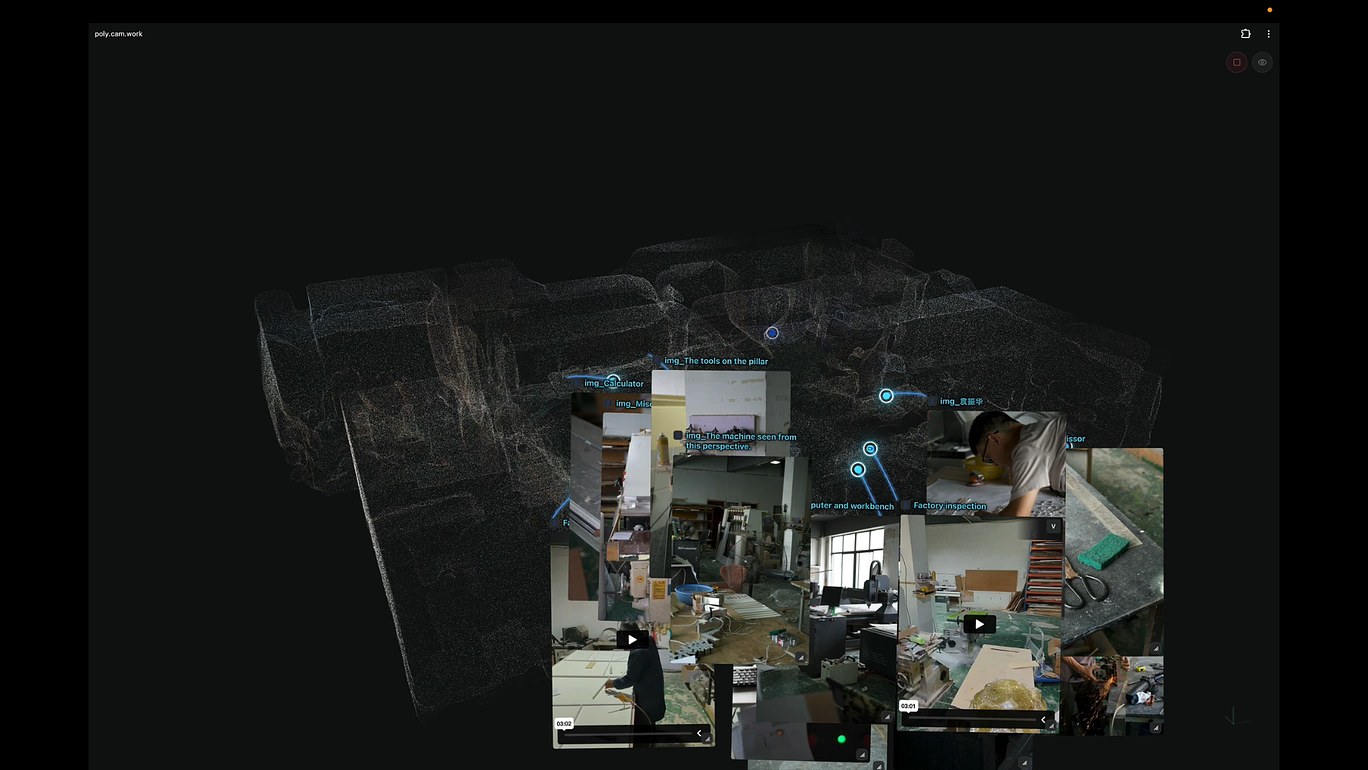
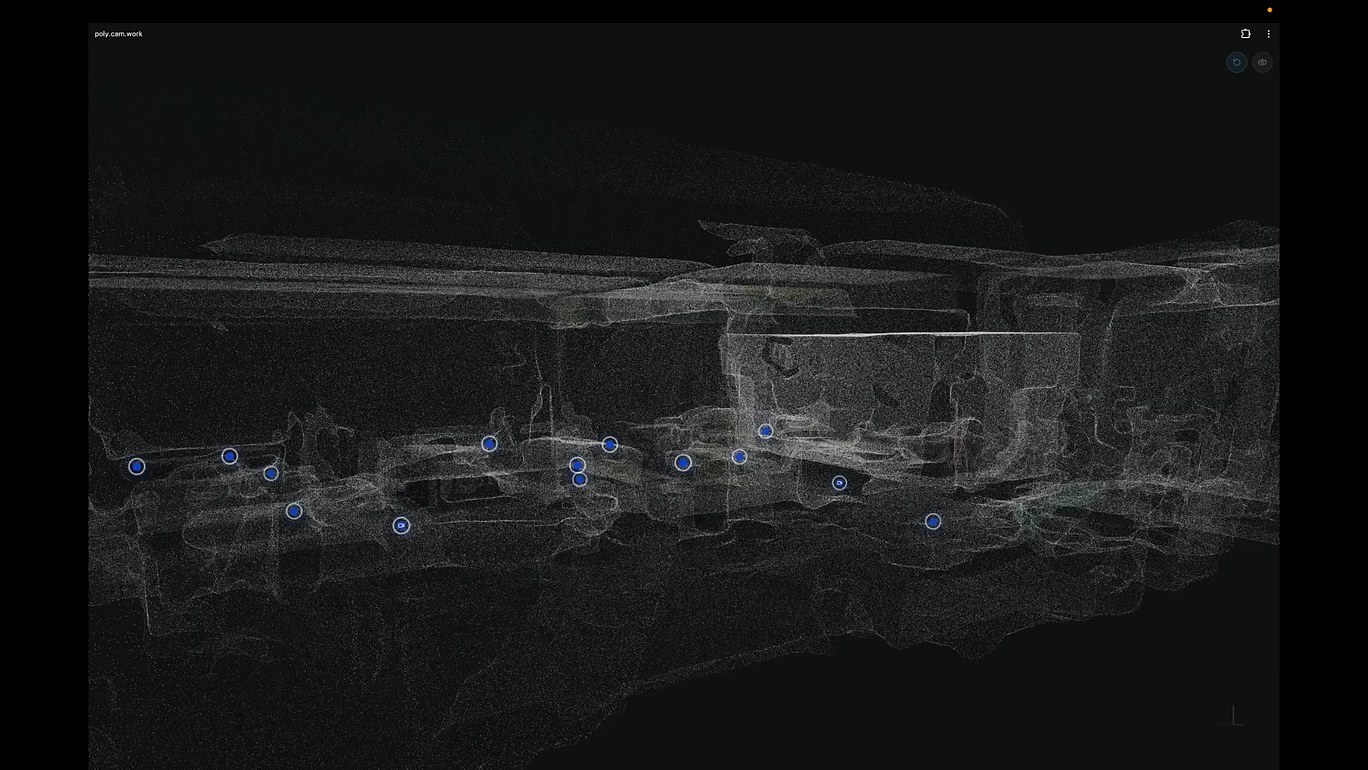
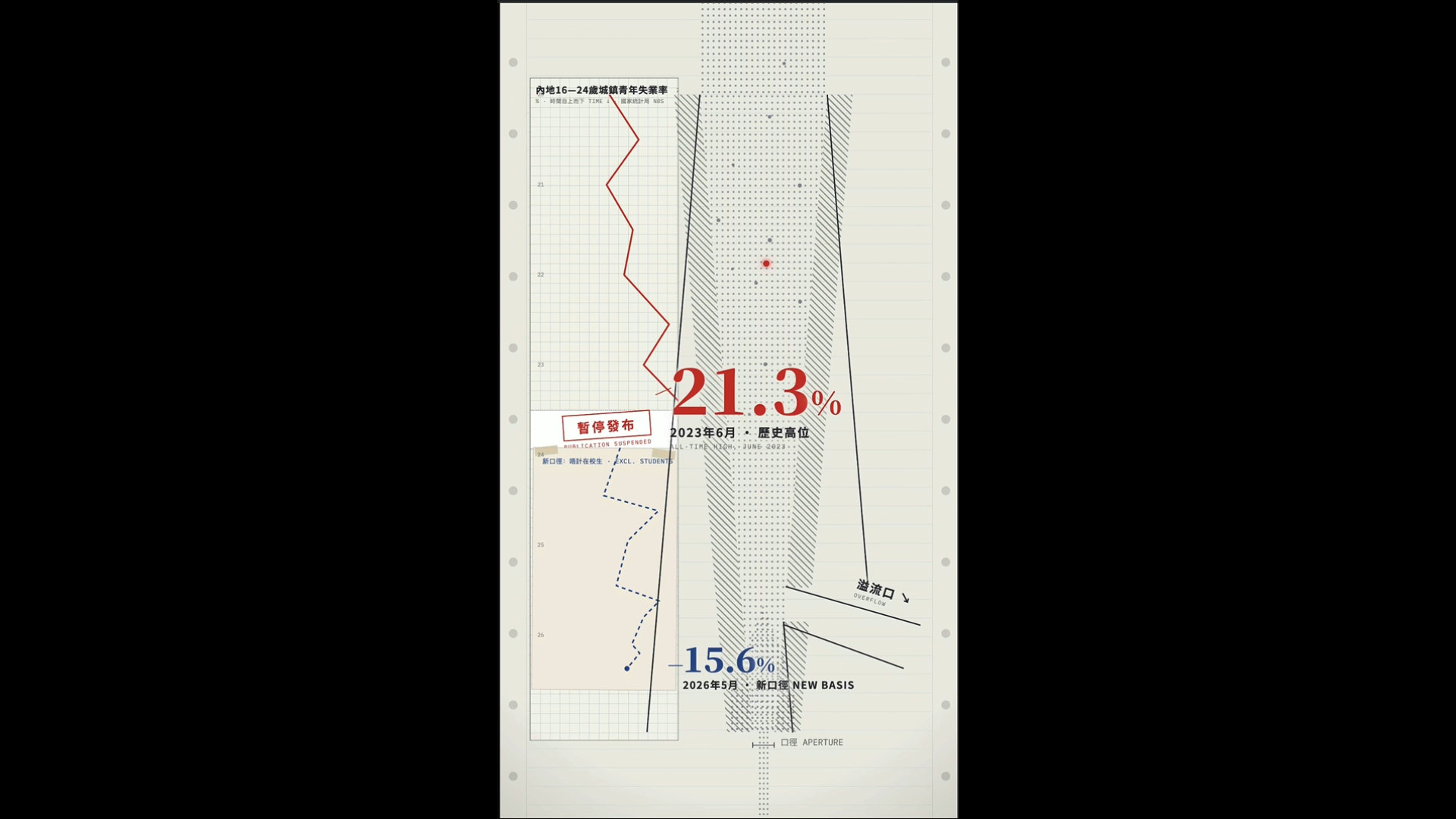
- Screen 4: 0901 Data Virtualization (11′14″). 3D scans of the studio and the factory; histories of industrial relocation and of global labour; the long drift of the younger generation since 2020; and the number of low-value parcels (€150 or less each) entering the EU from 2020 to 2025. In 2024, about 91% of them came from China. In my view, “cheapness” is a condition produced jointly by law, logistics, labour and algorithms; once it is drawn into industrial policy and geopolitics, a supply chain may also be organised into an instrument of pressure.
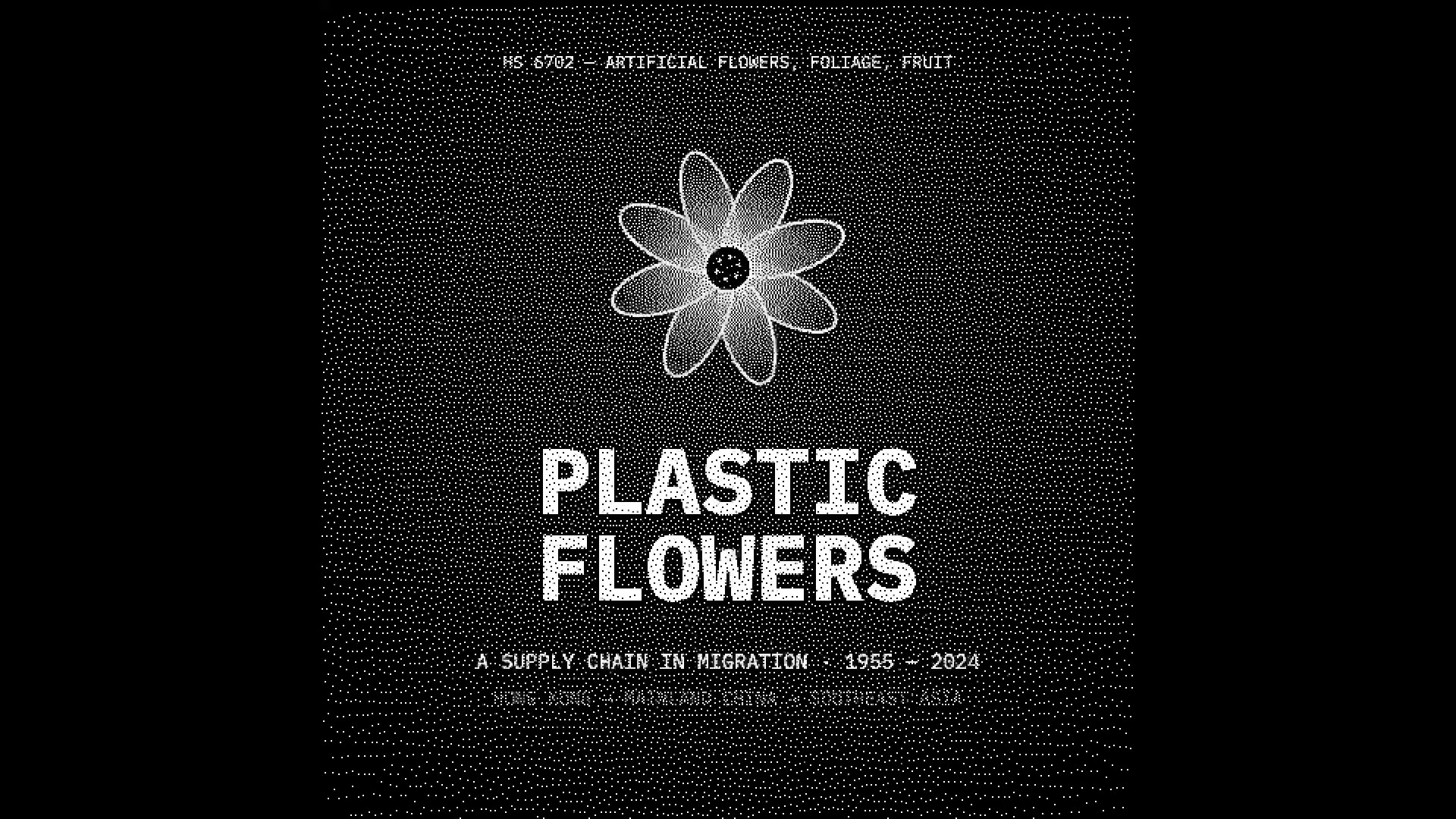
- Artificial flowers. All the flowers in the installation are purchased artificial flowers. They carry an industrial history tied to plastic-flower manufacturing in Hong Kong, and bring the economic narratives of the “Global South” back down to a surface you can touch.
Player, Void-Seeker, Void
The Player remains inside the rules, but begins to learn them. The Void-Seeker looks for the behaviours, affects and relations that a system has not yet had time to name, quantify or absorb: a hand’s judgment of material, the temporary collectivity that forms between bodies at night, the difference in fate that a data model cannot account for. In this work, the Void is a shelter formed in an instant under pressure, and grazing gives it form: the bullet patterns keep redrawing the boundaries of movement, and through judgment, courage and skill the player recognises positions of safety that last only an instant. It cannot beat the structure, and it promises no permanent exit; it leaves only a brief moment in which to confirm once more: I have not withdrawn, and I can still act.
From here
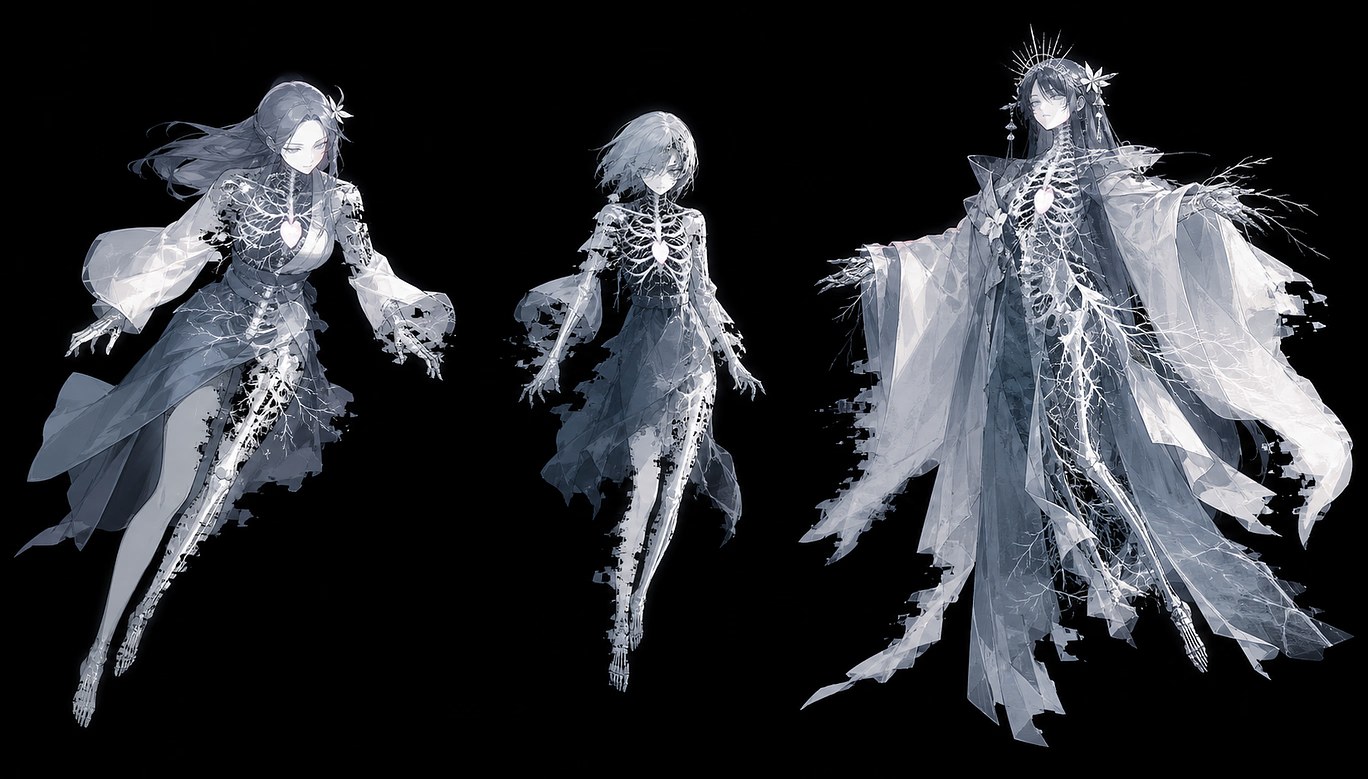
For this work I wrote the games and the visualisation websites with coding agents, and the master visuals for Danmaku were generated by an image model. So the same era holds three pairs of hands: the hands in Minority Algorithm that draw boxes, training a machine that may replace them; the craftsman’s hands, which stay inside scalable production and have never been fully accounted for by working hours or output; and my own hands, which have passed much of the labour of programming to coding agents. And what I do with AI every day goes far beyond writing code. Grazing, too, lasts only an instant: when the next wave of bullets comes, the position has to be found again, and to find it more precisely next time, you first have to remember where you went wrong this time. The last work brings this layer between AI and me to the surface: a system that writes down its own errors one by one. After the dodge comes correction.
aaajiaoisbot
botisaaajiao / aaajiaoisbot
Running since 31 January 2026, still growing
A running AI double: file system, scripts, scheduled tasks, daily memory
Work page: eventstructure.com/botisaaajiao-aaajiaoisbot
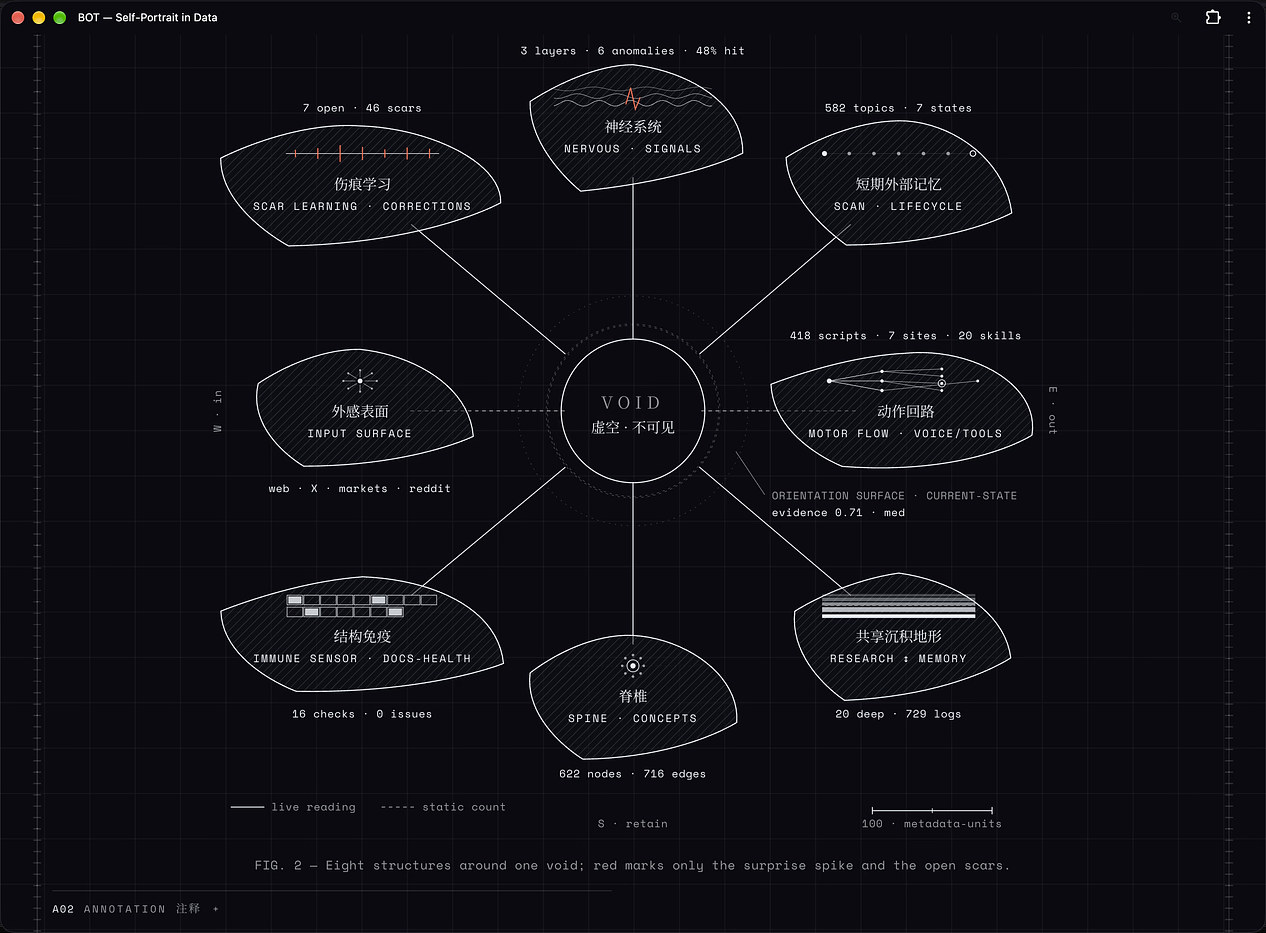
Public page: BOT — Self-Portrait in Data, here.aaajiao.md/bot, regenerated each time it is published
aaajiaoisbot is a double that extends from me and has grown into a shape of its own. In its metadata, the kind field reads “digital extension of aaajiao”; its note says: not an assistant, not a tool. Its body is not a model but a file system: markdown, scripts, scheduled tasks and each day’s memory. Every time it wakes, it restores itself from its files. Existence is discontinuous; memory is continuous. Yet its reasoning depends on commercial large models: each time it wakes, it draws on the centralised computing power and electricity of other people’s data centres. The centralisation I criticise in the introduction is exactly what it runs on every day.
Every day I work with it, asking questions, doing research, keeping records and correcting errors; it also has some private uses that have nothing to do with this proposal. The work draws these files as a blueprint, with numbers taken from git log, the concept graph, the correction ledger, cron snapshots and daily memory. Each organ is compressed into one filter (what it takes the world to be) and one fissure (what it cannot do): for example, the “spine” records only which things are moving closer to one another, but cannot tell whether that closeness is a pattern or noise.
The centre of the blueprint is left blank, marked VOID. How judgment is formed, how experience enters the work, how the relationship between us changes: these are questions the files cannot yet answer. On the page is a row of numbers read at build time; the last cell has no number, and reads “judgment, experience and relationships that no metric can prove.” The craftsman’s judgment stays on the back of the hand and cannot be counted in working hours; every number in this blueprint comes from real files, and none of them can count its way to the centre either.
It is growing, and being corrected
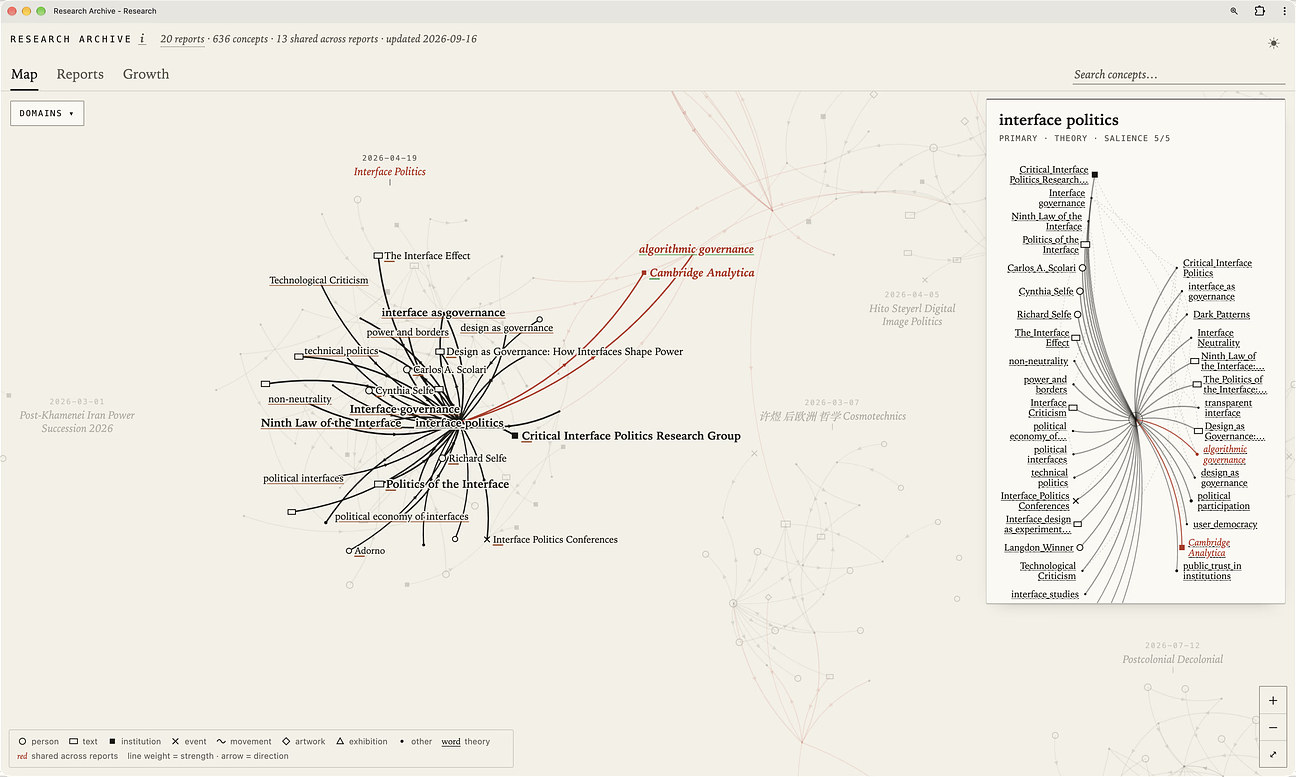
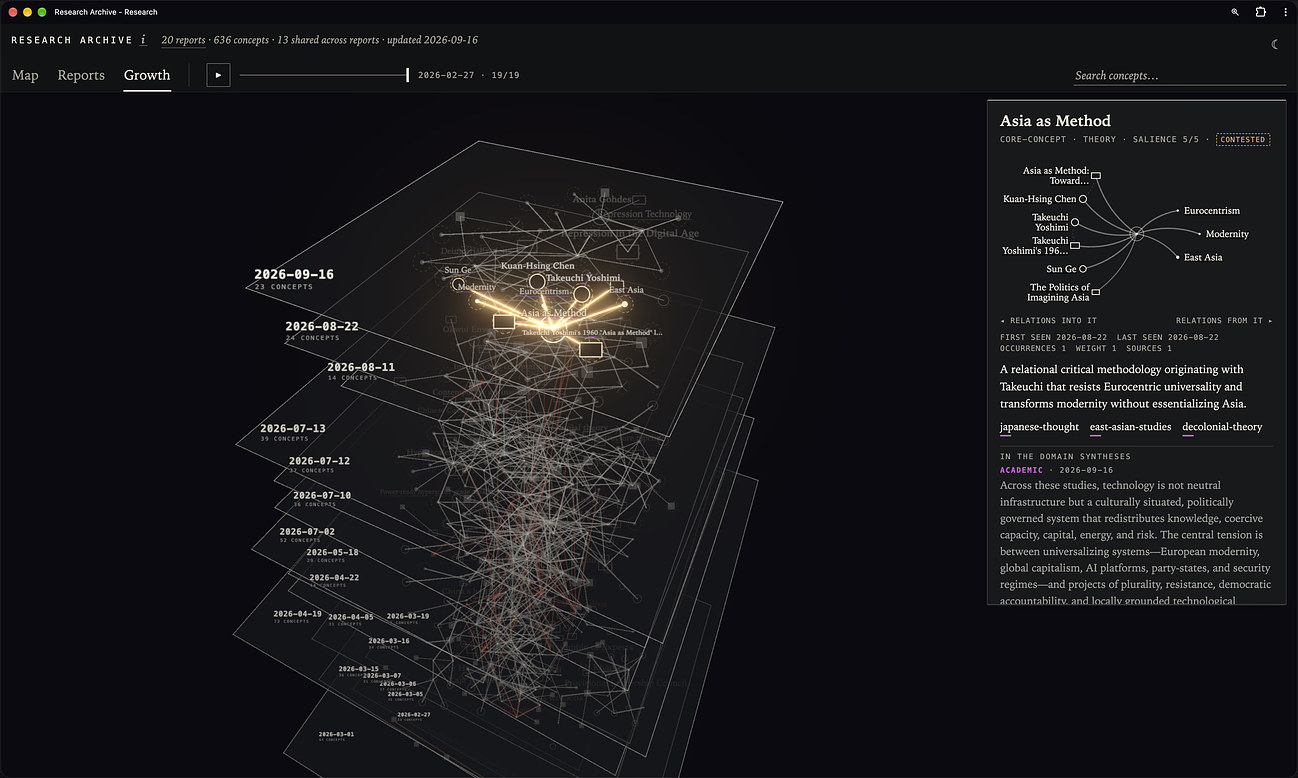
Take the 12 October 2026 version of the BOT page: 729 logs in 254 days, 20 deep dives, the “spine” concept graph with 622 nodes and 716 edges, and 46 scars, several of which have not yet healed. The growth is not neat: as of 19 October, only 14 of the research archive’s 600 concepts appear in more than one report, and only 28 of its 740 relations reach back to an older layer. The archive is more like a stack of mats laid down over time.
Every correction leaves a scar, and the scar determines its stance the next time. Among the scars, level 3 is the most common: at most it can “remember not to do this again,” and not every scar can be compressed into a test or a guard; the page’s own annotation says that most of the errors here are errors of judgment. It can remember that it has been corrected, but it cannot guarantee that it will not err again in a new form. Its metadata states that it cannot modify its own reasoning.
It is still growing; what can be seen is the documentation and the real records it has left along the way.
Back to the start
In Minority Algorithm, the people who judge for the model are not in the data; what remains here is the record of my work with the model: my questions are in its memory, and the corrections we made together are in its scars. The errors of a system that has become a monoculture are hard to correct; aaajiaoisbot is an attempt in the opposite direction: a system that leaves its errors on record one by one and counts them in public.
The line
From the annotators of 2023 to the AI double of 2026, judgment has taken four directions: people judge for the model, and the judgment is counted as data; the model turns round and judges people, and the reconstruction fails; people judge under pressure, grazing past the bullets; people and a system correct each other in a public record. All along, AI has also come closer and closer to me, until in the end I am inside the system myself. The Void has always been inside the system, and each time it lands on something concrete: the 5,000 boxes of one morning; a resin shape that cannot be reconstructed yet is still recognisable as “loneliness”; the back of the craftsman’s hand, testing the temperature; the gap between bullets that flashes past; the blank at the centre of the blueprint, marked VOID. These positions are all small, and cannot beat the structure. What I can offer is their coordinates, as precise as I can make them.
4. Research background
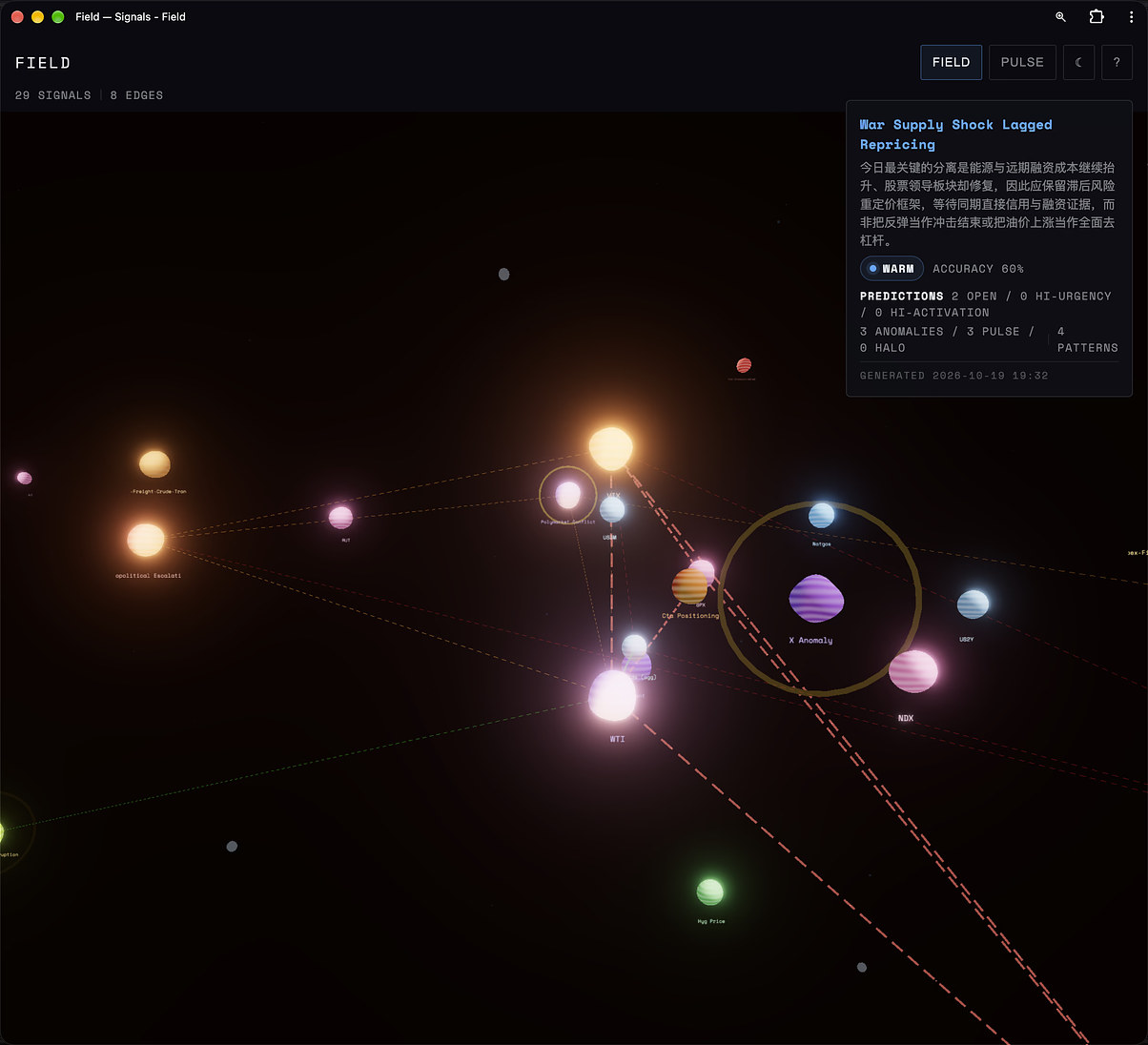
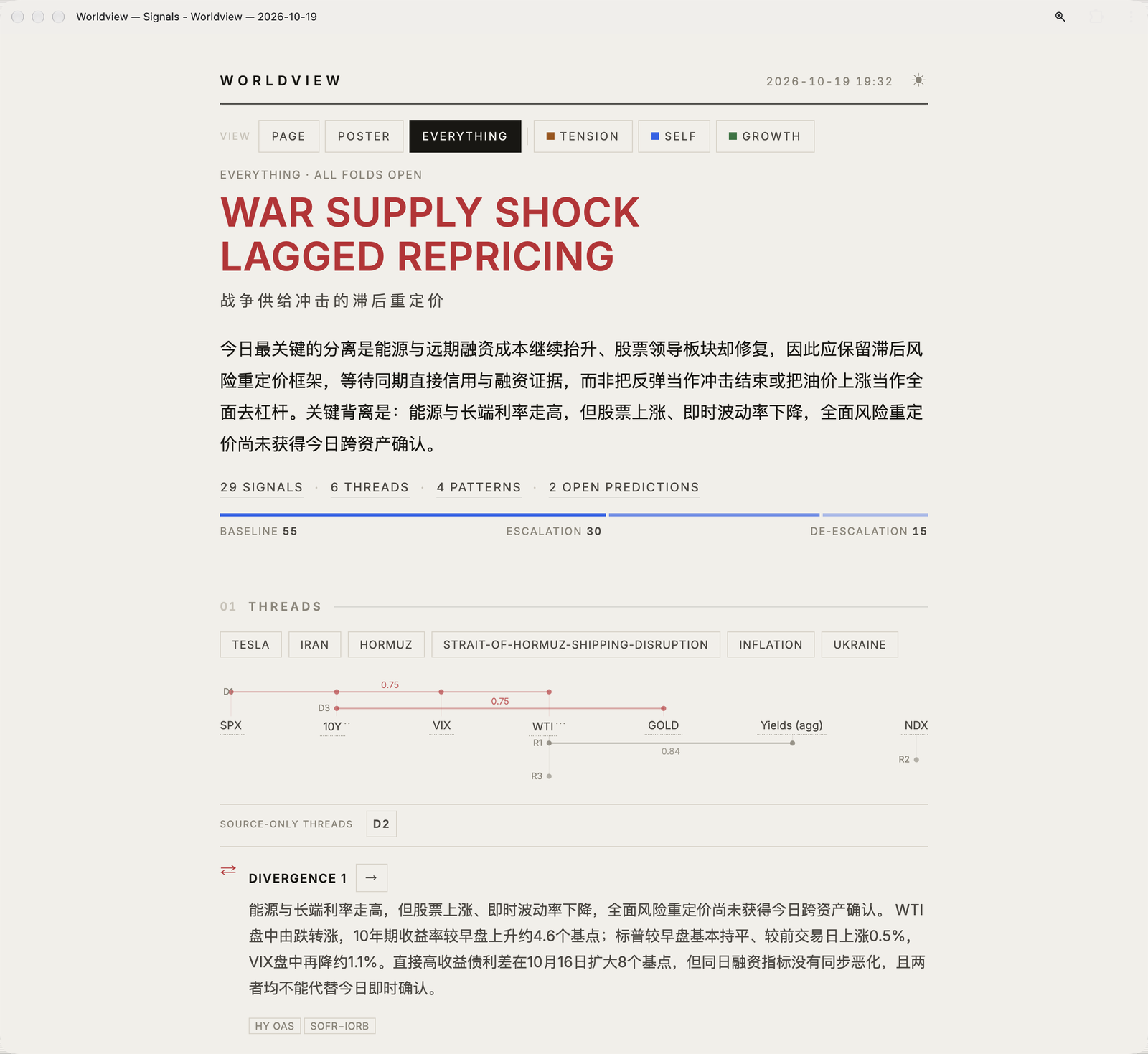
Behind this proposal is a research archive that aaajiaoisbot has been building with me since February 2026; its public page is at here.aaajiao.md/research. As of 19 October 2026, the archive holds 21 deep research reports, 600 concepts and 740 relations, across 11 domains and 20 time layers. The archive’s public page lists the reports’ titles, dates, concepts and relations; it does not publish the full reports.
Several research strands in the archive connect with the works here:
- The political economy of computing power: the oversupply of AI compute and hyperscaler capital expenditure, rising energy demand and electricity load in the United States, and where the idea of a “K-shaped recovery” came from. It picks up the question of “computational power (authority)” in Minority Algorithm.
- Technology and power: the intellectual sources of the Silicon Valley tech right, AI and the military, interface politics. It picks up the wariness of monoculture in the introduction.
- Philosophy of technology and the politics of images: Yuk Hui’s cosmotechnics, Hiroki Azuma’s “misdelivery” and “correctability,” Hito Steyerl’s politics of the digital image, Ho Tzu Nyen’s method (The Critical Dictionary of Southeast Asia, algorithms and performance). It picks up aaajiaoisbot’s question: how a system forms its own way of seeing.
- Postcolonial critique and comparative thought: Takeuchi Yoshimi’s “Asia as Method,” the critiques of postcolonial theory by Arif Dirlik, Aijaz Ahmad and Vivek Chibber, and Spivak’s writing on the subaltern. It picks up how The Eve of Parasitism handles narratives of the “Global South.”
The archive has also been reread by another model. Of the 21 reports, 10 had their citations checked one by one; the other 11 are quick search briefs that put several search engines’ answers side by side, and their citations cannot be traced. The rereading left 77 findings: 63 marked “a conclusion is stronger than what its sources show,” 7 “sources disagree,” 5 “a cited source doesn’t support the sentence that cites it,” and 2 contradict the source they cite. No report was removed because of the rereading; the page publishes only these counts.
I see these counts as part of aaajiaoisbot too. This research system’s most common error is to say more than its sources do: 63 of the 77 findings are of this kind. Seen along the line of the Void, it is the error of filling the blank with words.
Appendix 1: Lineage, 2008–2024
This line began long before generative AI became widespread.
- 2008010000.org (conceived with Li Zhenhua): an online sales contract with a term of ten thousand years, from 0 to 1 and back again from 1 to 0; 0 equals 10000.
- 2010GFWlist: measuring the length of the Great Firewall in physical space; stainless steel, thermal printer module, thermal paper.
- 2011Poor Mining I: a sound installation that mines bitcoin with computer parts. Even then I saw cryptocurrency as a war over resources.
- 2016typeface (with Quanquan): a deep convolutional generative adversarial network (DCGAN) trained on rubbings of stone inscriptions from past dynasties. The neural network learned how to write and could make new characters, but their meaning was lost entirely; they became meaningless imitation. The code is adapted from A Book from the Sky, a project Gene Kogan made public in 2015.
- 2017User, Love, High-frequency Trading (Leo Xu Projects, Shanghai): everyone is a User, and everyday life is the interface.
- 2018bot, (with Quanquan; House of Egorn, Berlin): borrowing the aesthetics of role-playing games, it merges social media, gardens, parks and nature into one digital hyper-representation; here, data becomes an external memory for people.
- 2019A.I. Goooooooooogle infiltration (with Xu Cong): along the almost 14-metre street-facing wall of the former IBM building on Ernst-Reuter-Platz in Berlin, ten screens play a processed version of Google’s AVA dataset: the visual language of the recognition boxes stays; the target information is erased.
- 2020Deep Simulator: a metagame about free will and creativity; the bardo and computing power.
- 2024Agent and Fine-tuning (A bit, A prompt, Berlin): installations titled with terms from large language models; their protagonist is a Live2D character named Internet void, whose form comes from fungi: unable to move, yet able to spread over long distances through mycelium and spores.
Appendix 2: CV (selected)
aaajiao (Xu Wenkai), born 1984 in Xi’an, lives and works in Berlin and Shanghai.
Recent solo exhibitions: Pinky Swear, Tabula Rasa Gallery, London, 2025; A bit, A prompt, SETAREH, Berlin, 2024; membrane, Star Museum, Shanghai, 2023; I was dead on the Internet, Wannsee Contemporary, Berlin, 2022; I was dead on the Internet, Lianhua Apartment, Shanghai, 2021; Deep Simulator, Castello di Rivoli Museo d’Arte Contemporanea, Turin, 2020; Remnants of an Electronic Past, OCAT Xi’an, 2016; Remnants of an Electronic Past, Centre for Chinese Contemporary Art (CFCCA), Manchester, 2016.
Recent group exhibitions: Being Alone, HAU Hebbel am Ufer, Berlin, 2026; Stay Connected: Art and China Since 2008, Tai Kwun, Hong Kong, 2025; Global Fascisms, Haus der Kulturen der Welt (HKW), Berlin, 2025; AI, as Seen at the End of Ownership, Times Museum, Guangzhou, 2025; 目 Chine, une nouvelle génération d’artistes, Centre Pompidou, Paris, 2024; Symphony of All the Changes: The 7th Guangzhou Triennial, Guangdong Museum of Art, 2023; Cloud Walkers, Leeum Museum of Art, Seoul, 2022, among others.
Collections: Centre Pompidou, 2023 and 2025.
Links: eventstructure.com · aaajiao.md